Introduction
Choosing bearings for OEM automotive programs involves more than matching load ratings to a catalog. Engineers and sourcing teams must weigh duty cycle, speed, friction, sealing, material performance, manufacturing tolerances, and supplier quality against strict cost and warranty targets. The right decision influences drivetrain efficiency, noise and vibration, service life, and the risk of expensive field failures across high production volumes. This article outlines the main selection criteria for automotive bearings in OEM supply, explains how those criteria affect reliability and total cost, and provides a practical framework for evaluating bearing options across conventional and electrified vehicle platforms.
How Automotive Bearings Affect OEM Cost and Reliability
The selection of automotive bearings is a critical engineering and procurement exercise that directly dictates the operational lifecycle, warranty liability, and assembly costs for original equipment manufacturers (OEMs). Although bearings represent a relatively small fraction of a vehicle’s total bill of materials, their performance defines the mechanical efficiency of powertrains, chassis dynamics, and auxiliary systems. For OEM supply chain and engineering teams, optimizing bearing selection requires navigating complex trade-offs between unit cost, long-term reliability, and evolving vehicle architectures.
Why Bearings Matter in OEM Supply
In high-volume automotive production, the financial impact of bearing reliability is asymmetrical. A sub-standard bearing with a unit cost of $5 to $15 can precipitate catastrophic system failures, routinely escalating into warranty claims exceeding $800 per vehicle when factoring in dealership labor, replacement parts, and administrative overhead. Consequently, OEMs demand exceptional durability to mitigate the risk of mass recalls.
Furthermore, bearings are central to reducing parasitic mechanical losses. By minimizing rolling resistance, high-performance bearings contribute directly to achieving stringent corporate average fuel economy (CAFE) standards and maximizing electric vehicle (EV) battery range. A reduction in friction torque by even 10% across a vehicle’s drivetrain can yield measurable improvements in overall energy efficiency, making bearing selection a strategic component of vehicle homologation.
How Vehicle Duty Profiles Change Bearing Needs
The ongoing transition from internal combustion engines (ICE) to electrified powertrains has fundamentally altered bearing duty profiles. Traditional ICE bearings operate under high-vibration, high-temperature, and moderate-speed conditions. In contrast, EV traction motors subject bearings to extreme rotational velocities, with modern architectures routinely demanding operational speeds exceeding 20,000 RPM. This shift necessitates advanced internal geometries and specialized cage designs to withstand immense centrifugal forces.
Additionally, EVs introduce unique electrical and acoustic challenges. Bearings in electric motors are susceptible to electrical pitting caused by stray high-frequency currents discharging through the rolling elements, requiring engineered solutions such as ceramic balls or specialized insulating coatings. Simultaneously, the absence of the masking effect of engine noise in EVs means bearing-induced noise, vibration, and harshness (NVH) must be strictly controlled, often requiring acoustic emissions to remain below 40 dB under operational loads.
Technical Criteria for Evaluating Automotive Bearings
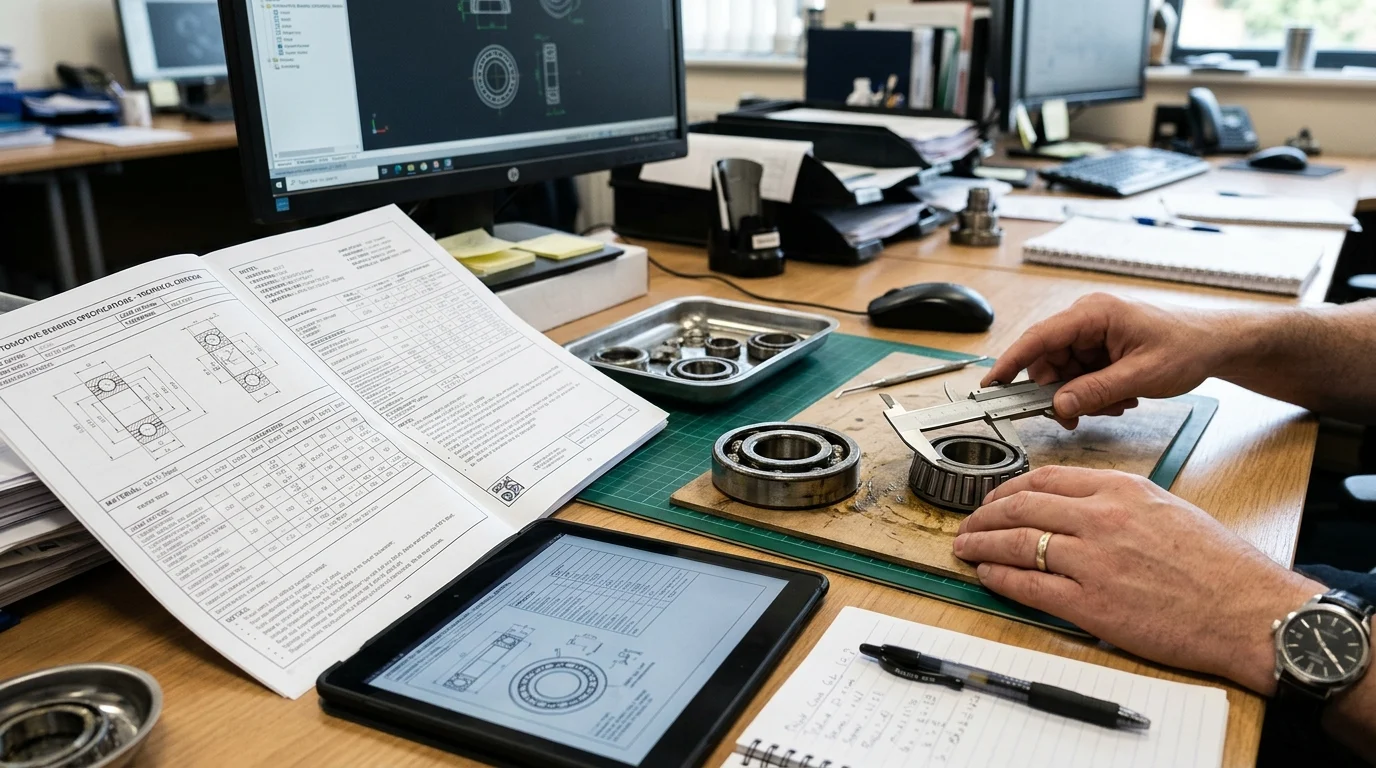
Evaluating automotive bearings requires a rigorous analysis of mechanical, thermal, and tribological specifications. Engineering teams must match the bearing’s physical characteristics to the exact demands of the application, ensuring that the component operates within its optimal performance envelope throughout the vehicle’s intended lifecycle.
Load, Speed, NVH, Friction, and Thermal Requirements
The fundamental parameters governing bearing selection are dynamic load capacity and rotational speed limits. For high-speed applications like EV motors, engineers utilize the dN value (bore diameter in millimeters multiplied by maximum RPM) to gauge performance limits. Modern automotive traction bearings must frequently support dN values exceeding 1.5 million. At these extremes, managing friction and the resulting thermal output becomes critical to preventing premature grease degradation and catastrophic seizure.
NVH requirements dictate the internal micro-geometry of the bearing. Raceway super-finishing, strict adherence to ABEC 5 (or higher) precision classes, and optimized internal clearances (such as C3 or C4 to accommodate thermal expansion) are mandatory to minimize vibration. Thermal requirements further dictate that bearings maintain dimensional stability across a wide operating spectrum, typically ranging from -40°C in cold-weather starts to localized peaks of 150°C in heavy-duty transmission environments.
Materials, Seals, and Lubrication Systems
Material selection is the foundation of bearing longevity. The industry standard remains high-carbon chromium bearing steel (100Cr6), often subjected to advanced heat treatments like carbonitriding to enhance surface hardness and fatigue resistance. For environments prone to electrical erosion or extreme speeds, hybrid bearings utilizing silicon nitride (Si3N4) ceramic rolling elements offer superior electrical insulation and a 40% reduction in centrifugal mass compared to steel balls.
Sealing and lubrication systems are equally critical, as lubrication failure accounts for a majority of premature bearing failures. Automotive bearings typically employ low-friction, non-contact labyrinth seals or advanced contact seals made from polyacrylic rubber (ACM) or fluoroelastomers (FKM) to prevent contaminant ingress while minimizing drag. Grease fill volumes are strictly controlled—often specified between 25% and 35% of the bearing’s free internal space—to balance adequate lubrication with the prevention of thermal runaway caused by grease churning at high speeds.
Ball, Roller, and Tapered Bearing Comparison
The choice of bearing topology depends entirely on the specific load vectors and spatial constraints of the automotive sub-system. Deep groove ball bearings, cylindrical roller bearings, and tapered roller bearings each offer distinct mechanical advantages.
| Bearing Type | Primary Load Capacity | Speed Limit | Relative Friction | Typical Automotive Application |
|---|---|---|---|---|
| Deep Groove Ball | Radial (Moderate), Axial (Light) | Very High | Low | Alternators, EV Motors, AC Compressors |
| Cylindrical Roller | Radial (High), Axial (None) | High | Medium | Transmissions, Differential Pinions |
| Tapered Roller | Radial (High), Axial (High) | Moderate | High | Wheel Hubs, Heavy-Duty Axles |
OEM engineers utilize this comparative matrix to optimize space and performance. For example, wheel hub assemblies predominantly rely on double-row tapered roller bearings due to their ability to handle the severe combined radial and axial loads generated during vehicle cornering, despite their higher inherent rotational friction compared to standard ball bearings.
How OEM Teams Should Assess Bearing Suppliers
Identifying the right bearing specification is only half the challenge; OEMs must also rigorously evaluate the manufacturing and operational capabilities of potential suppliers. The integrity of an automotive supply chain relies on suppliers who can consistently deliver precision components at scale, without deviation from approved tolerances.
Quality Systems, Process Controls, and Validation
Automotive OEMs require bearing suppliers to maintain stringent quality management systems, universally mandated through IATF 16949 certification. However, certification alone is insufficient. Procurement and quality teams must audit the supplier’s statistical process control (SPC) data to ensure manufacturing stability. A capable automotive bearing supplier should consistently demonstrate a Process Capability Index (Cpk) greater than 1.67 for critical-to-quality dimensions, such as raceway diameter and surface roughness.
Validation processes must align with OEM product development cycles. Suppliers are expected to conduct rigorous in-house bench testing, including accelerated life testing, mud-slurry ingress testing for seals, and acoustic chamber evaluations. The ability of a supplier to provide comprehensive, data-backed validation reports significantly reduces the OEM’s internal testing burden and accelerates the time-to-market for new vehicle platforms.
Make-or-Buy, Localization, Capacity, and Total Cost
The strategic decision of whether to rely on off-the-shelf catalog bearings or to commission custom-engineered solutions (make-or-buy) hinges on volume and application uniqueness. Custom bearings require significant upfront tooling investments and typically demand Minimum Order Quantities (MOQs) ranging from 10,000 to 50,000 units per production run. OEMs must weigh these initial costs against the long-term performance benefits and potential assembly efficiencies.
Localization and capacity are critical pillars of supplier assessment. OEMs increasingly prefer suppliers with regional manufacturing footprints to mitigate geopolitical risks, reduce transit times, and lower carbon footprints. Evaluating a supplier’s total cost of ownership (TCO) extends beyond the piece price; it incorporates logistics, inventory holding costs, tariff liabilities, and the supplier’s surge capacity to accommodate sudden fluctuations in vehicle production schedules.
Compliance, Testing, and Supply Chain Factors
Integrating a bearing into an automotive production line involves navigating a complex web of industry standards, regulatory compliance, and logistical constraints. OEMs must ensure that every batch of bearings not only meets engineering specifications but is also delivered in a condition ready for immediate, defect-free assembly.
Standards, PPAP, Traceability, and Warranty
Compliance in automotive bearing supply is strictly governed by the Production Part Approval Process (PPAP). Suppliers must submit Level 3 PPAP documentation, verifying that the manufacturing process is stable and capable of producing components to ISO 281 standards for dynamic load ratings. This documentation includes design records, failure mode and effects analysis (DFMEA/PFMEA), and control plans.
Traceability is non-negotiable for warranty management and recall containment. Tier 1 and OEM manufacturers require bearings to feature permanent identification—such as laser-etched QR codes or alphanumeric lot numbers—linking each unit to specific steel heats, production shifts, and dimensional inspection records. This level of traceability is essential for supporting modern automotive warranty periods, which frequently extend to 10 years or 150,000 miles.
Logistics, Packaging, Shelf Life, and Regional Manufacturing
The physical delivery of bearings requires specialized logistics to prevent degradation before assembly. Bearings are highly susceptible to micro-fretting during transit and oxidation if exposed to ambient moisture. Consequently, suppliers must utilize Volatile Corrosion Inhibitor (VCI) packaging, vacuum-sealed bags, or specialized plastic dunnage that isolates individual units to absorb transit vibrations.
Shelf life management is a critical supply chain factor. The lubricating grease within a bearing undergoes chemical degradation and oil separation over time, even in optimal storage conditions. OEMs typically enforce a strict maximum shelf life of 3 to 5 years for sealed bearings. To manage this, supply chain teams must coordinate closely with regional manufacturing hubs to ensure just-in-time (JIT) delivery, accommodating typical production lead times of 16 to 24 weeks without risking inventory obsolescence.
Decision Framework for Selecting Automotive Bearings
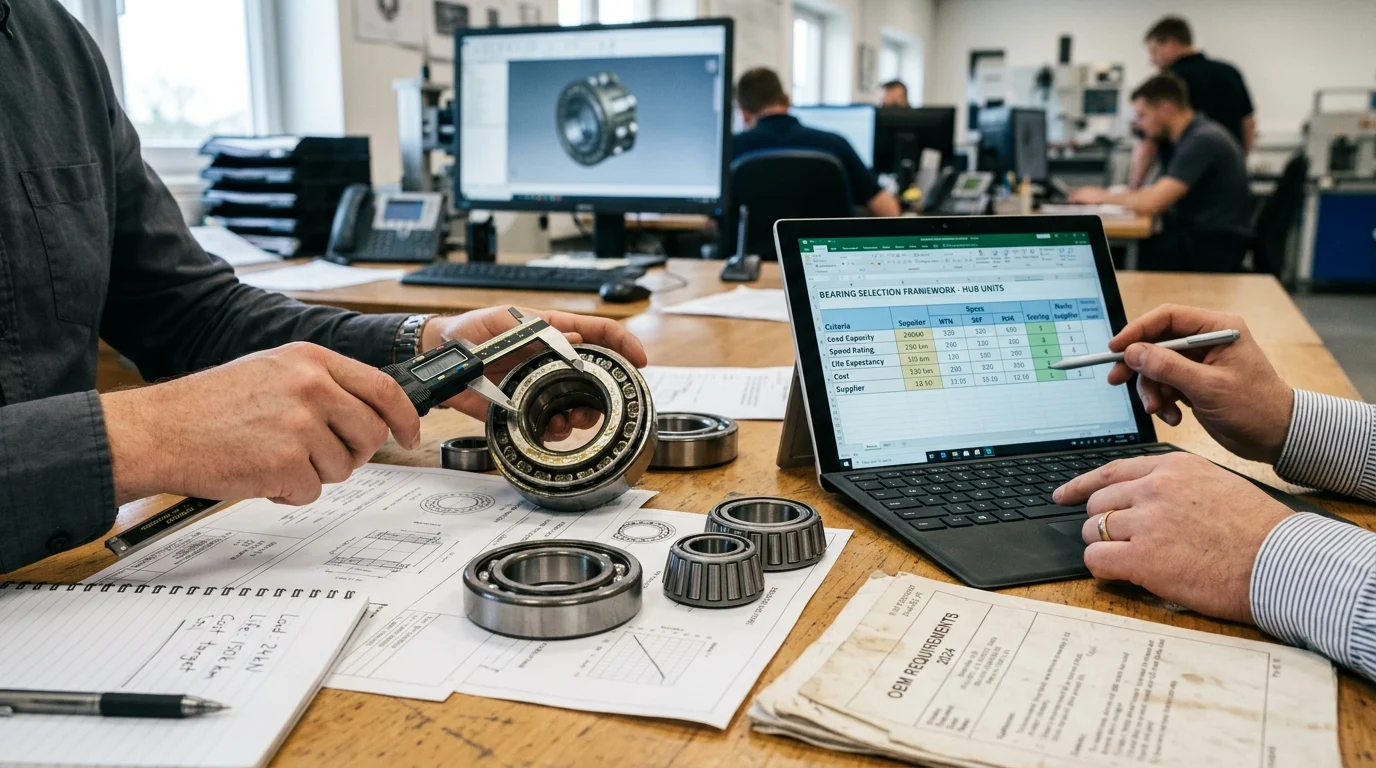
Synthesizing the technical, commercial, and logistical variables into a cohesive decision requires a structured framework. OEMs achieve the best outcomes by employing a cross-functional approach that prevents siloed decision-making, ensuring that cost-reduction initiatives do not inadvertently compromise vehicle safety or performance.
Step-by-Step Cross-Functional Selection Process
A robust selection process operates through a phase-gate methodology. In the initial design phase, engineering teams define the absolute boundary conditions—maximum loads, spatial constraints, and target lifespans. Purchasing teams then map these requirements against the approved vendor list (AVL) to identify candidates capable of meeting the specifications within the target cost band.
During the prototyping and validation phases, quality assurance (QA) teams are integrated to audit the supplier’s PPAP readiness and localized manufacturing capabilities. By forcing Engineering, Purchasing, and Quality to sign off at each gate, the OEM ensures that the selected bearing is technically viable, economically sustainable, and manufacturable at high volumes with minimal variance.
Balancing Performance, Compliance, Risk, and Cost
Ultimately, bearing selection is an exercise in multi-variable optimization. A premium bearing might offer a 10% to 15% mass reduction and superior NVH characteristics, but it may also carry a 30% cost premium and require extended lead times. Teams must utilize a weighted decision matrix to quantify these trade-offs objectively.
| Evaluation Category | Key Metric | Target Threshold | Typical Weighting |
|---|---|---|---|
| Technical Performance | L10 Fatigue Life, NVH (dB) | > 150,000 miles, < 40 dB | 40% |
| Quality & Compliance | Defect Rate, Cpk | < 1 PPM, > 1.67 Cpk | 25% |
| Commercial Cost | Unit Price, Tooling Amortization | Within BOM target | 20% |
| Supply Chain Risk | Lead Time, Localization | < 16 weeks, Regional Plant | 15% |
By applying this quantitative framework, OEM teams can systematically balance the demand for cutting-edge performance against the rigid realities of compliance, supply chain continuity, and total landed cost. This rigorous approach ensures the final bearing selection effectively supports the overall strategic goals of the vehicle platform.
Key Takeaways
- The most important conclusions and rationale for Automotive Bearings
- Specs, compliance, and risk checks worth validating before you commit
- Practical next steps and caveats readers can apply immediately
Frequently Asked Questions
What are the most important criteria when selecting automotive bearings for OEM supply?
Match load, speed, temperature, NVH, sealing, and lubrication to the exact application. For OEM programs, also verify dimensional tolerance, service life targets, and consistent batch quality.
How do EV applications change automotive bearing requirements?
EV bearings often need higher speed capability, lower noise, and protection against stray-current damage. Hybrid ceramic or insulated designs are commonly used for traction motors.
Which bearing materials are typically best for automotive OEM use?
100Cr6 bearing steel is standard for many automotive applications. For high-speed or electrical insulation needs, silicon nitride ceramic rolling elements can improve durability and reduce electrical pitting.
How can OEM buyers reduce warranty risk when sourcing bearings?
Choose suppliers with automotive quality systems such as ISO/TS16949, stable process control, and full testing capability. Request validation data for life, noise, clearance, and seal performance.
Can DEMY Bearings support custom automotive bearing selection for OEM projects?
Yes. DEMY Bearings offers a broad automotive bearing range and catalog-based support, helping OEM and industrial buyers compare types, specifications, and application-fit options efficiently.
Post time: May-20-2026