Introduction
In industrial equipment, roller bearing selection affects far more than fit and rotation: it influences load capacity, heat generation, maintenance intervals, and the risk of costly downtime. Because different bearing types handle radial loads, axial forces, speed, misalignment, and contamination in different ways, choosing the right one requires matching operating conditions to design features rather than relying on price or habit. This article explains the key selection factors, the tradeoffs between common roller bearing designs, and the practical questions engineers should ask before specifying a bearing for demanding industrial service.
Why roller bearings matter in industrial applications
Roller bearings serve as the foundational rotational components in heavy industrial machinery. They are structurally distinct from ball bearings due to their line-contact geometry, which allows them to distribute mechanical stress over a significantly larger surface area. This fundamental design difference enables roller bearings to accommodate much higher radial and axial load capacities.
Selecting the correct roller bearing architecture directly dictates system reliability, energy efficiency, and operational longevity. A rigorous selection process ensures that mechanical systems can operate continuously under punishing industrial conditions without experiencing catastrophic failure or requiring excessive maintenance interventions.
Impact on total cost of ownership
The initial acquisition cost of a roller bearing typically represents a mere 10 to 15 percent of its Total Cost of Ownership (TCO). The remaining 85 to 90 percent stems from maintenance labor, lubrication regimens, and the financial impact of unplanned downtime.
For instance, a premature bearing failure in a continuous casting machine or paper mill can easily incur production losses exceeding $25,000 per hour. Consequently, optimizing bearing selection based on lifecycle endurance rather than immediate unit price is a fundamental engineering and financial imperative.
Applications with the highest performance demands
Heavy-duty industrial sectors present extreme kinematic and environmental challenges that push roller bearings to their absolute design limits. Wind turbine main shafts, for example, subject spherical roller bearings to massive dynamic loads often exceeding 5 meganewtons (MN), all while operating at low rotational speeds and enduring high structural deflection.
Similarly, mining aggregate crushers and steel rolling mills require bearings capable of withstanding severe shock loads and heavy particulate contamination. These applications necessitate specialized raceway profiles, advanced metallurgy, and robust sealing solutions to prevent catastrophic spalling and premature fatigue.
Define roller bearing requirements before comparing options
An objective evaluation of operational parameters must precede any comparative analysis of bearing brands or models. Engineers must translate the physical demands of the machinery into precise kinematic and environmental specifications to narrow down the available architectural options.
Load, speed, misalignment, temperature, and contamination factors
The primary variables dictating bearing architecture include radial and axial load vectors, operational speeds, shaft misalignment, ambient temperatures, and contamination ingress. Standard bearing steel (such as 52100) typically maintains dimensional stability up to 120°C (250°F), whereas specialized heat-stabilized variants are required for environments reaching 200°C to 350°C.
Speed parameters, often evaluated using the ndm value (pitch diameter in millimeters multiplied by RPM), dictate lubrication and cage requirements. Applications exceeding 500,000 ndm generally necessitate precision-machined cages and circulating oil systems rather than standard grease packing to manage heat generation and centrifugal forces.
Differences among cylindrical, spherical, tapered, and needle bearings
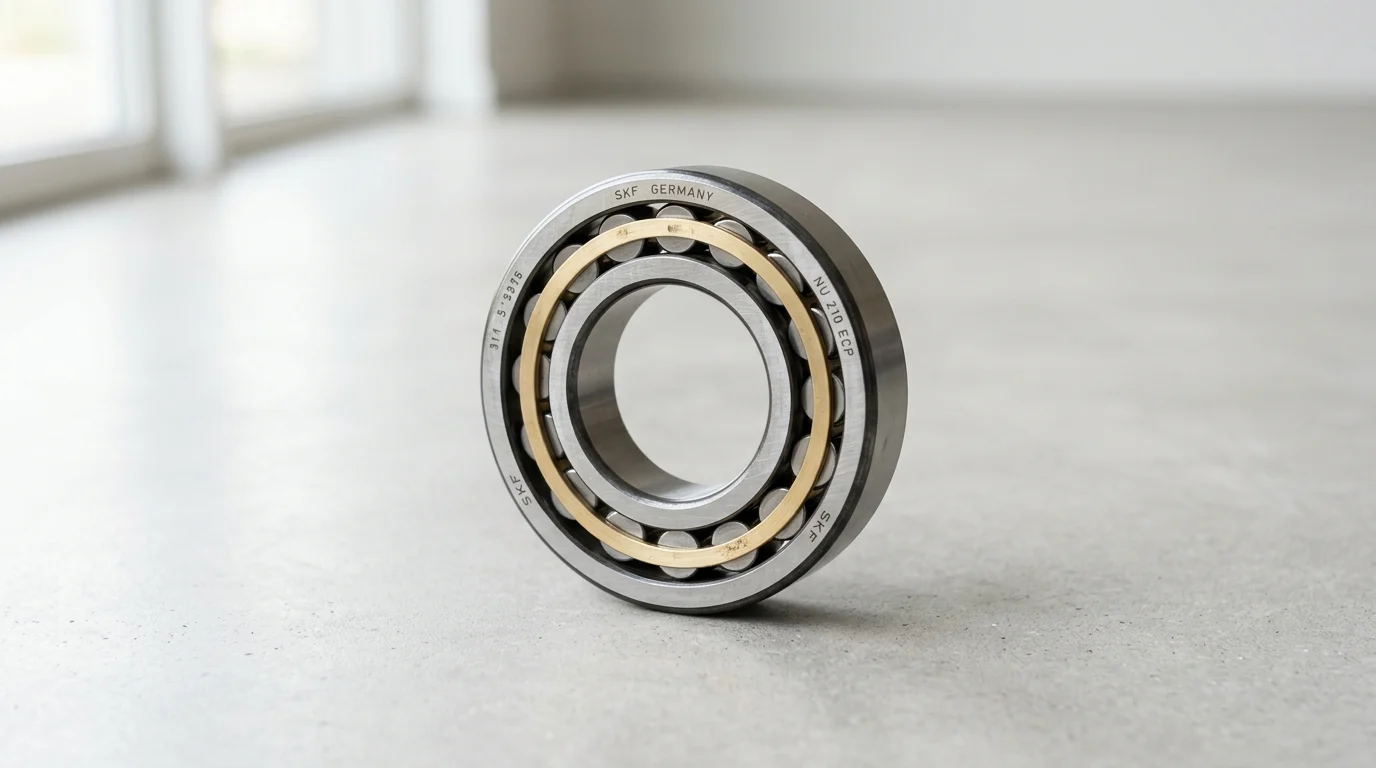
The specific geometry of the rolling elements determines the bearing’s primary functional capabilities and limitations. Cylindrical roller bearings excel in high-speed, heavy radial load applications but offer minimal axial load support. Spherical roller bearings accommodate heavy combined loads and tolerate significant shaft misalignment, typically between 1.5 and 2.0 degrees.
Tapered roller bearings manage simultaneous heavy radial and unidirectional axial loads, and are frequently deployed in opposing pairs to handle bidirectional forces. Needle roller bearings feature a high length-to-diameter ratio, providing exceptional radial load capacity within a highly constrained radial envelope.
| Bearing Type | Primary Load Capacity | Misalignment Tolerance | Typical Speed Capability |
|---|---|---|---|
| Cylindrical | High Radial | Very Low (< 0.1°) | High |
| Spherical | Very High Radial & Axial | High (1.5° – 2.0°) | Low to Moderate |
| Tapered | High Combined (Radial/Axial) | Low (< 0.1°) | Moderate |
| Needle | High Radial (Compact) | Very Low (< 0.1°) | Moderate to High |
Internal clearance, cage, sealing, and material choices
Internal clearance, cage design, sealing, and material composition represent critical sub-specifications. Radial internal clearance, designated from C2 to C5, must account for operational thermal expansion. Electric motor applications frequently specify C3 clearance to accommodate a 10°C to 15°C temperature differential between the inner and outer rings.
Cage materials range from stamped steel to machined brass or glass-fiber reinforced polyamide (PA66). However, PA66 cages are generally limited to continuous operating temperatures below 120°C and can degrade in the presence of certain synthetic lubricants. Integral seals offer an initial defense against contaminants, though heavily contaminated environments always require robust external housing seals.
Compare roller bearings across technical and commercial criteria
Once technical requirements are established, procurement professionals and reliability engineers must align these specifications with commercial realities. This phase involves navigating catalog ratings, supply chain volatility, and rigorous lifecycle cost justifications.
Key specifications and rating methods
Bearing performance is universally evaluated using the Dynamic Load Rating (C) and Static Load Rating (C0) as defined by ISO 281 and ISO 76 standards. The fundamental L10 life calculation predicts the number of operational hours or revolutions that 90 percent of a group of identical bearings will survive before the onset of metal fatigue.
Modern engineering practices utilize the modified rating life (L10mh). This advanced calculation incorporates specific factors for lubrication conditions, contamination levels, and specific steel fatigue limits, providing a highly accurate projection of field reliability compared to the baseline L10 formula.
Price, lead time, interchangeability, warranty, and availability
Commercial variables frequently dictate the final sourcing decision. While lead times for standard catalog items may be a few days, large-bore bearings exceeding 500mm in outer diameter or customized designs frequently carry lead times of 24 to 36 weeks.
Interchangeability across major tier-one manufacturers requires strict verification of boundary dimensions according to ISO 15, as well as confirmation of internal geometry. Furthermore, warranty terms and localized inventory availability through authorized distribution networks are critical for minimizing operational risk and ensuring rapid replacement during unplanned outages.
When premium bearings are worth the cost
Premium bearings from top-tier manufacturers typically command a 40 to 80 percent price premium over economy alternatives. This premium is justified by superior steel cleanliness, optimized raceway micro-geometry, and tighter manufacturing tolerances, which collectively extend fatigue life.
Investing in premium bearings is financially imperative in applications where replacement labor costs dwarf the component price. They are also essential in highly inaccessible locations, such as offshore wind gearboxes and subsea pumping stations, where the cost of a maintenance intervention is prohibitively high.
Reduce sourcing risk with quality and compliance checks
The global bearing market is highly fragmented, presenting significant supply chain risks. Implementing stringent quality assurance and compliance protocols is essential to prevent the integration of substandard or counterfeit components into critical industrial infrastructure.
How to evaluate manufacturers, distributors, and OEM channels
Evaluating the supply channel is just as important as evaluating the bearing itself. Procurement should be strictly restricted to OEM-direct channels or officially authorized distributors.
The World Bearing Association estimates that counterfeit bearings cost the global industrial sector over $3 billion annually, posing severe risks of catastrophic machinery failure and operator injury. Independent brokers or unauthorized gray-market vendors should be heavily scrutinized and generally avoided for mission-critical applications.
Quality documentation, traceability, and inspection requirements
Rigorous quality documentation ensures traceability from the steel mill to the final assembly. Buyers should mandate Material Test Reports (MTRs) conforming to EN 10204 Type 3.1 to verify metallurgical composition and steel cleanliness.
Additionally, dimensional and running accuracy inspection reports are necessary to confirm compliance with specified tolerance classes. Comprehensive traceability protocols require permanent laser-etched batch codes on the bearing rings, allowing manufacturers to isolate and recall specific production lots if defect trends emerge.
Standards, certifications, and application-specific compliance
Adherence to international standards guarantees interoperability and baseline quality. Bearings are manufactured to specific tolerance classes defined by ISO, ABMA, or DIN bodies.
| Standard Body | Standard Reference | Normal Tolerance | High Precision | Ultra-High Precision |
|---|---|---|---|---|
| ISO | ISO 492 | Normal (Class 0) | Class 6 / Class 5 | Class 4 / Class 2 |
| ABMA (Radial) | ABEC / RBEC | ABEC 1 / RBEC 1 | ABEC 3 / RBEC 5 | ABEC 7 / RBEC 9 |
| DIN | DIN 620 | P0 | P6 / P5 | P4 / P2 |
Application-specific compliance is also vital. Food and beverage processing facilities demand bearings utilizing FDA-approved solid lubricants (H1 food grade) and corrosion-resistant stainless steel. Similarly, aerospace and military applications require adherence to AS9100 quality management standards and rigorous non-destructive testing (NDT) protocols.
Make the final roller bearing selection decision

The final selection of an industrial roller bearing represents the synthesis of mechanical engineering analysis, environmental assessment, and strategic procurement. A structured methodology prevents costly oversights and ensures long-term asset reliability.
A step-by-step selection process
A repeatable selection process begins with defining the available spatial envelope, specifically the maximum allowable bore, outer diameter, and width. Next, engineers must calculate the equivalent dynamic bearing load, factoring in the exact ratio of radial to axial forces.
The third step is calculating the required L10mh modified rating life based on the machine’s intended duty cycle. Following life calculations, the appropriate lubrication strategy and internal clearance are selected. The final step involves cross-referencing these technical requirements against lead times and budget constraints to select the optimal manufacturer.
Common mistakes that cause premature failure
Several common specification errors lead to premature bearing failure. Over-specifying precision is a frequent commercial mistake; utilizing a P4 (ABEC 7) precision bearing where a Normal (Class 0) tolerance is sufficient can unnecessarily inflate component costs by 200 to 300 percent.
Conversely, under-loading a bearing is a critical technical error. Roller bearings require a minimum load—typically at least 2 percent of the dynamic load rating (C)—to maintain rolling traction. Insufficient load causes the rollers to skid across the raceway, generating rapid smearing and catastrophic surface degradation. Finally, neglecting to specify proper mounting fits can result in clearance loss, excessive operating temperatures, and immediate failure upon commissioning.
Key Takeaways
- The most important conclusions and rationale for roller bearings /
- Specs, compliance, and risk checks worth validating before you commit
- Practical next steps and caveats readers can apply immediately
Frequently Asked Questions
Which roller bearing type is best for heavy radial loads at high speed?
Cylindrical roller bearings are usually the best fit. They handle high radial loads and higher speeds well, but they provide little axial load support and need good shaft alignment.
When should I choose spherical roller bearings?
Choose spherical roller bearings when your machine has heavy combined loads, shaft deflection, or misalignment. They are common in crushers, conveyors, mining equipment, and other tough-duty industrial applications.
How do I select the right internal clearance for roller bearings?
Match clearance to operating temperature, fit, and speed. For example, C3 is often used when thermal expansion is expected, such as in motors or continuously running industrial equipment.
Do seals matter when choosing roller bearings for dirty environments?
Yes. In dusty, wet, or contaminated conditions, proper sealing helps prevent grease loss and particle ingress. This is especially important for agriculture, conveyors, mining, and other high-contamination applications.
Can DEMY Bearings help OEMs and distributors choose suitable roller bearings?
Yes. DEMY Bearings offers a broad roller bearing range plus e-catalog support, making it easier for OEMs, distributors, and equipment manufacturers to match load, speed, and application requirements.
Post time: May-21-2026