Performance Economics of Deep Groove Ball Bearings
The deployment of deep groove ball bearings in high-speed electric motors—such as those utilized in electric vehicle (EV) traction systems, aerospace actuators, and high-frequency industrial spindles—requires a rigorous approach to mechanical design and lifecycle economics. As modern electric motors push operational boundaries, frequently exceeding 20,000 RPM, bearings become the primary limiting factor for system reliability. The selection process must move beyond basic load ratings to encompass complex thermo-mechanical dynamics, where excessive friction or inadequate heat dissipation rapidly leads to catastrophic failure.
From an economic perspective, specifying bearings for these extreme environments involves navigating the tension between upfront component costs and long-term operational integrity. Engineers must evaluate whether standard 52100 bearing steel configurations can survive the duty cycle or if the application justifies the premium for advanced materials and precision manufacturing. A holistic total cost of ownership (TCO) model must account for the bearing’s purchase price, the cost of specialized lubrication, and the financial impact of potential premature motor failure.
High-Speed Performance Factors
High-speed performance in deep groove ball bearings is primarily quantified by the speed factor ($nd_m$), calculated by multiplying the rotational speed in RPM ($n$) by the bearing’s pitch circle diameter in millimeters ($d_m$). Advanced electric motors increasingly operate in the $nd_m$ range of 1.0 × 10^6 to 1.5 × 10^6 mm/min. At these velocities, centrifugal forces exerted by the rolling elements against the outer raceway escalate exponentially, altering contact angles and generating severe internal friction.
Additionally, high rotational speeds induce centrifugal expansion of the bearing’s inner ring. If the interference fit between the motor shaft and the inner ring is compromised, micro-slip or fretting wear can occur. Engineers must calculate the required shaft interference to maintain a secure fit at maximum RPM without inducing excessive hoop stress at rest, which could prematurely exhaust the bearing’s internal clearance and cause thermal runaway.
Trade-Offs Between Speed, Load, and Cost
Optimizing a bearing for high-speed operation typically compromises its load-carrying capacity. High-speed deep groove ball bearings often utilize smaller rolling elements to reduce centrifugal mass and lower friction, which inherently decreases the dynamic load rating ($C$). Consequently, engineers face a direct trade-off: selecting a bearing robust enough to handle radial and axial loads from the motor rotor, yet light enough to prevent excessive heat generation at peak RPM.
This technical trade-off directly impacts project economics. Upgrading from a standard ABEC 3 (ISO P6) precision class to an ABEC 7 (ISO P4) class to minimize high-speed vibration can increase the per-unit cost by 40% to 60%. Similarly, specifying specialized polymer cages or high-speed polyurea greases adds incremental costs. Procurement and engineering teams must collaboratively determine the exact performance threshold where the marginal cost of higher precision yields diminishing returns in motor efficiency and warranty reduction.
Key Specifications for Speed and Reliability

Specifying deep groove ball bearings for high-speed electric motors requires granular attention to internal geometry, tolerances, and boundary dimensions. Standard off-the-shelf selections are rarely sufficient for dynamic environments where thermal gradients and rapid acceleration are the norm. Every specification, from the bore size to the synthetic thickener in the grease, must be engineered to mitigate the specific failure modes associated with high-velocity rotation.
The specification process is iterative. An initial selection based on boundary dimensions must be continually refined as thermal modeling and rotor dynamic analyses reveal the actual operating conditions. This rigorous methodology ensures that the bearing will maintain elastohydrodynamic lubrication (EHL) film thickness under all operating extremes.
Bearing Series, Bore Size, and Load Ratings
The selection begins with the bearing series and bore size, which dictate the boundary dimensions and internal space available for rolling elements. High-speed motors frequently utilize thin-section bearing series, such as the 6800 and 6900 series, or the light 6000 series. Compared to medium or heavy series, thin-section bearings feature smaller balls, which significantly reduces centrifugal force and skidding at high speeds, albeit at the expense of overall load capacity.
The dynamic load rating ($C$) and static load rating ($C_0$) must be cross-referenced with the motor’s rotor weight and any external radial or axial loads (such as those from gearing or belts). For high-speed applications, the dynamic equivalent load ($P$) should typically not exceed 5% to 8% of the dynamic load rating ($C$). Operating below this threshold ensures fatigue life is maximized, though engineers must also ensure a minimum load is applied to prevent the balls from sliding rather than rolling, a phenomenon that rapidly degrades the raceway surface.
Internal Clearance, Precision Class, and Runout
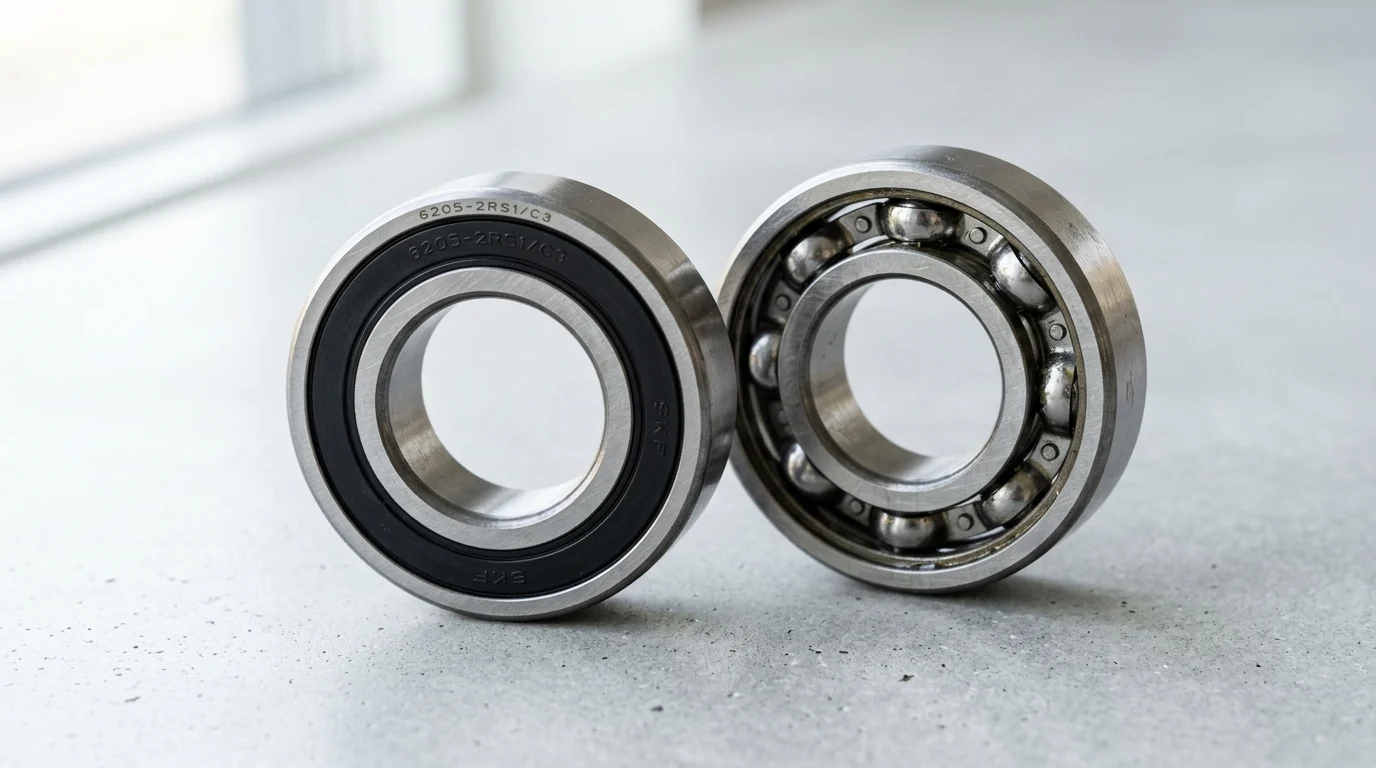
Internal clearance is arguably the most critical specification for thermal management in high-speed deep groove ball bearings. As the motor operates, the inner ring and rolling elements typically run hotter than the outer ring, causing differential thermal expansion that reduces the internal clearance. To prevent the bearing from operating with a negative clearance (preload), which causes immediate thermal runaway, C3 or C4 radial internal clearances are standard for high-speed electric motors. For example, a 6205 bearing with C3 clearance provides 13 to 28 micrometers of radial play at room temperature, accommodating typical operational thermal gradients.
Precision class dictates the dimensional and running accuracy of the bearing. High-speed electric motors require tight control over radial and axial runout to minimize vibration and acoustic noise. Specifying an ABEC 5 (ISO P5) or ABEC 7 (ISO P4) tolerance class limits radial runout to under 4 to 5 micrometers for typical motor shaft sizes. This high precision ensures the rotor remains dynamically balanced, reducing cyclical stress on the bearing and preventing destructive resonance frequencies from propagating through the motor housing.
Cage Design, Seals, and Lubrication
Cage design, sealing, and lubrication form the tribological core of the bearing. Standard two-piece steel ribbon cages are prone to fatigue failure under high centrifugal forces. Instead, high-speed deep groove ball bearings utilize lightweight, low-friction cages made from glass-fiber reinforced polyamide (PA66) or polyether ether ketone (PEEK). PEEK cages are particularly suited for extreme environments, maintaining structural stability at continuous operating temperatures up to 150°C to 200°C.
Sealing solutions must balance contamination protection with friction reduction. Contact seals (RS/RS1) generate excessive heat at high speeds and are generally avoided. Non-contact labyrinth seals (RZ/2RZ) or metal shields (ZZ) are preferred, as they retain grease without adding rotational drag. Lubrication relies on low-viscosity synthetic greases, often utilizing ester or synthetic hydrocarbon base oils with polyurea thickeners. A base oil viscosity of 20 to 30 cSt at 40°C is typical, ensuring sufficient film thickness without excessive churning losses.
The table below illustrates the typical trade-offs between different cage and seal configurations in high-speed environments:
| Component Type | Material / Design | Max Speed Factor ($nd_m$) | Temp Limit (°C) | Friction Impact |
|---|---|---|---|---|
| Cage | Polyamide (PA66) | Up to 1.0 × 10^6 | 120°C | Low |
| Cage | PEEK | Up to 1.5 × 10^6 | 200°C | Very Low |
| Seal | Contact Seal (RS) | < 0.4 × 10^6 | Material dependent | High |
| Seal | Non-Contact (RZ) | Up to 1.2 × 10^6 | Material dependent | Minimal |
Comparison With Alternative Bearing Options
While deep groove ball bearings manufactured from 52100 high-carbon anti-friction bearing steel are the industry standard for electric motors, extreme operational parameters frequently necessitate evaluating alternative bearing technologies. As electric motor topologies evolve—particularly with the adoption of high-voltage architectures and silicon carbide (SiC) inverters—the demands placed on bearings transcend basic mechanical rotation, entering the realms of electrical insulation and advanced material science.
Engineers must objectively compare standard steel deep groove ball bearings against alternatives such as hybrid ceramic deep groove ball bearings and angular contact ball bearings (ACBBs). This comparative analysis must weigh technical superiority against commercial viability, ensuring the selected bearing architecture aligns perfectly with the motor’s specific torque-speed curve, axial load requirements, and target lifecycle cost.
Comparison Criteria for Bearing Selection
The primary criteria for comparing bearing architectures include maximum speed limits, load-carrying capacity (both radial and axial), system stiffness, and susceptibility to electrical damage. Standard deep groove ball bearings excel in handling moderate radial loads and minor axial loads in both directions, making them highly versatile. However, if the electric motor features helical gearing that generates substantial unidirectional axial thrust, standard deep groove designs may suffer from edge loading on the raceways.
In applications with high axial loads, angular contact ball bearings are often evaluated as an alternative. ACBBs feature asymmetric raceways that support significant thrust loads, but they must be installed in pairs (e.g., back-to-back or face-to-face) and require precise axial preload. This adds complexity to the motor assembly process and increases the overall axial footprint, which can be detrimental in power-dense motor designs where space is at a premium.
Hybrid Ceramic Bearing Advantages
For ultra-high-speed and electrically demanding applications, hybrid ceramic deep groove ball bearings offer substantial technical advantages over standard steel variants. Hybrid bearings utilize standard steel inner and outer rings but replace the steel rolling elements with bearing-grade silicon nitride ($Si_3N_4$) ceramic balls. Silicon nitride possesses a density of approximately 3.2 g/cm³, which is roughly 40% the weight of bearing steel. This drastic reduction in mass proportionally reduces centrifugal forces and gyroscopic moments at high speeds, allowing hybrid bearings to comfortably operate at $nd_m$ values exceeding 1.2 × 10^6.
Furthermore, silicon nitride is an inherent electrical insulator, boasting a dielectric strength greater than 15 kV/mm. Modern electric motors driven by high-frequency pulse-width modulated (PWM) inverters are highly susceptible to parasitic common-mode voltages. If this voltage discharges through the bearing, it causes electrical discharge machining (EDM), resulting in micro-cratering, fluting on the raceways, and rapid degradation of the grease. Hybrid ceramic bearings completely block these destructive discharge currents, eliminating the need for complex grounding rings or costly conductive greases.
Application Fit and Limitations
Despite their technical superiority, hybrid ceramic bearings and complex ACBB arrangements have distinct application limitations, primarily driven by cost and handling sensitivity. Hybrid ceramic deep groove ball bearings typically command a price premium of 300% to 500% over their all-steel counterparts. This cost multiplier restricts their use to high-value applications, such as premium EV traction motors, high-speed turbomachinery, and precision machine tool spindles, where the cost of failure far outweighs the component premium.
Additionally, ceramic balls possess a significantly higher modulus of elasticity than steel, making them extremely rigid. While this increases bearing stiffness, it also reduces the contact ellipse area under load, creating higher contact stresses on the steel raceways. Consequently, hybrid bearings are more susceptible to true brinelling if subjected to shock loads during motor assembly or transit.
The following table summarizes the comparative metrics across the three primary bearing options for high-speed motors:
| Bearing Architecture | Relative Max Speed | Axial Load Capacity | Electrical Insulation | Relative Cost |
|---|---|---|---|---|
| Steel Deep Groove | Baseline (1.0x) | Low to Moderate | None | 1.0x (Baseline) |
| Hybrid Ceramic DGBB | High (1.3x – 1.5x) | Low to Moderate | Excellent (>15 kV/mm) | 3.0x – 5.0x |
| Angular Contact (Pair) | High (1.2x) | High (Unidirectional) | None | 2.5x – 3.5x |
Validation Before Production
Theoretical engineering calculations and catalog specifications serve only as the foundation for bearing selection. Before a deep groove ball bearing can be approved for mass production in a high-speed electric motor, it must undergo rigorous empirical validation. This testing phase bridges the gap between simulated physics and real-world operational variances, ensuring the bearing can survive the actual duty cycle of the final application.
A structured validation framework mitigates catastrophic field failures and costly product recalls. This framework must encompass lifespan testing, environmental stress screening, and strict material traceability. By subjecting prototype bearings to conditions that mimic or exceed normal operation, engineers can identify marginal designs, optimize lubrication formulations, and establish baseline quality metrics for future production batches.
Selection Process Based on Duty Cycle
The validation process begins by correlating the bearing’s theoretical $L_{10h}$ fatigue life with the motor’s anticipated duty cycle. Using ISO 281 standards, the $L_{10h}$ calculation provides the number of hours 90% of a bearing population will survive under a given load and speed. For industrial high-speed motors operating continuously, a target life of 20,000 to 30,000 hours is standard. Conversely, EV traction motors operate under highly variable dynamic loads and speeds, often targeting an $L_{10h}$ life of 8,000 to 10,000 hours based on a weighted average of the vehicle’s driving cycle.
Validation rigs must replicate this duty cycle, subjecting the bearing to rapid acceleration profiles, variable radial loads, and fluctuating thermal conditions. Accelerated life testing (ALT) is frequently employed, where the bearing is run at elevated speeds or loads to induce fatigue faster than real-time operation. The data extracted from these tests allows engineers to refine the dynamic equivalent load calculations and confirm that the selected internal clearance (e.g., C3) adequately accommodates the thermal expansion observed during peak torque demands.
Testing for Vibration, Noise, and Temperature
High-speed electric motors demand exceptionally low Noise, Vibration, and Harshness (NVH) profiles. Bearing validation requires comprehensive vibration analysis using Anderon meters or specialized accelerometer test rigs. The bearing’s vibration velocity is measured across three frequency bands: Low (50-300 Hz), Medium (300-1800 Hz), and High (1800-10000 Hz). Excessive vibration in the high-frequency band often indicates microscopic raceway defects, inadequate grease distribution, or geometric runout issues that will severely compromise high-speed stability.
Concurrently, temperature stabilization testing is critical. Thermocouples are utilized to monitor the bearing’s outer ring temperature during a prolonged high-speed run. A properly specified deep groove ball bearing should reach a steady-state operating temperature that is safely below the thermal limits of its components. For instance, if the bearing utilizes a standard PA66 cage and standard synthetic grease, validation testing must confirm that the continuous operating temperature does not exceed 110°C to 120°C, ensuring the grease thickener does not degrade and release its base oil prematurely.
Standards, Materials, and Traceability
Validation extends beyond physical testing to include the verification of manufacturing standards, material purity, and batch traceability. High-speed performance is highly sensitive to non-metallic inclusions within the bearing steel, which act as stress concentrators and initiate subsurface fatigue spalling. Validation requires metallurgical certifications confirming adherence to ISO 683-17 or ASTM A295 standards for 100Cr6 or SUJ2 bearing steels, specifically verifying that oxygen content remains below 10 to 15 parts per million (ppm) to ensure high fatigue resistance.
Traceability protocols must be established during the validation phase to guarantee that the quality of production units matches the prototypes. This includes tracing the specific heat lot of the steel, the manufacturing batch of the polymer cage, and the exact formulation date of the lubricant. Strict statistical process control (SPC) data should be reviewed to ensure critical dimensions, such as bore diameter and radial internal clearance, maintain a standard deviation of less than 2 micrometers across production runs, guaranteeing consistent high-speed performance in every motor assembled.
Sourcing and Final Selection
The culmination of the bearing selection process transitions focus from mechanical engineering to strategic procurement and supply chain management. Identifying a deep groove ball bearing with the perfect technical specifications is futile if the component cannot be reliably sourced at scale, within budget, and on schedule. The final selection phase requires aligning the engineering validation data with commercial realities and supplier capabilities.
Navigating the global bearing market requires a sophisticated approach to supplier evaluation. Procurement teams must differentiate between manufacturers capable of consistently producing high-precision, high-speed variants and those focused on high-volume commodity bearings. The final sourcing decision rests on a complex matrix of quality assurance, logistical resilience, and total lifecycle economics.
Supplier Qualification Factors
Supplier qualification for high-speed electric motor bearings mandates rigorous quality system audits. For automotive and EV applications, suppliers must hold active IATF 16949 certification, demonstrating robust defect prevention and variance reduction capabilities. Industrial applications typically require ISO 9001 compliance as a baseline. Furthermore, the supplier’s manufacturing facilities must be evaluated for their grinding and honing capabilities, as achieving the ABEC 5 or ABEC 7 tolerances required for high-speed operation necessitates state-of-the-art CNC grinding equipment and strict environmental controls.
Cleanliness during bearing assembly is another critical qualification factor. Microscopic particulate contamination introduced during assembly will act as an abrasive compound at 20,000 RPM, rapidly destroying the raceways and degrading the grease. Qualified suppliers must execute final washing, grease injection, and sealing operations within certified cleanrooms, typically meeting ISO Class 7 (Class 10,000) or better standards, to ensure the internal environment of the bearing remains pristine prior to installation.
Cost, Lead Time, and Availability
Commercial negotiations must balance unit cost with Minimum Order Quantities (MOQs) and lead times. High-speed deep groove ball bearings often require custom radial internal clearances, specialized PEEK cages, or niche polyurea greases. These non-standard configurations prevent suppliers from fulfilling orders from existing stock. Consequently, MOQs for custom high-speed bearings can range from 1,000 to 10,000 units per batch, requiring careful inventory planning and capital allocation by the motor manufacturer.
Lead times for specialized bearings can also pose significant supply chain risks. While standard steel bearings may be available within 4 to 6 weeks, custom configurations requiring specialized cage tooling or imported ceramic rolling elements can extend lead times to 16 to 24 weeks. Procurement teams must factor these extended timelines into product launch schedules and establish safety stock agreements or vendor-managed inventory (VMI) programs to protect against production line stoppages.
Final Decision Framework
The final decision framework should utilize a weighted scoring matrix that aggregates technical performance, commercial viability, and supplier risk. Technical scores are derived from the validation testing phase, weighting factors such as thermal stability, NVH performance, and predicted $L_{10h}$ life. Commercial scores evaluate unit cost, tooling investments, and MOQ flexibility. Risk factors assess the supplier’s geopolitical location, financial stability, and historical on-time delivery performance.
Ultimately, the selection of deep groove ball bearings for high-speed electric motors must not be treated as
Key Takeaways
- Use the ndm speed factor to screen bearing suitability, especially when electric motors operate near 1.0 × 10^6 to 1.5 × 10^6 mm/min.
- Evaluate thermal behavior, centrifugal force, internal clearance, and fit conditions instead of relying only on static or dynamic load ratings.
- Balance speed and load capacity carefully because smaller rolling elements reduce friction but can also lower the bearing dynamic load rating.
- Specify shaft interference fit to prevent micro-slip at maximum RPM without eliminating internal clearance or triggering thermal runaway.
- Treat bearing selection as a total cost of ownership decision that includes component price, lubrication, precision class, downtime risk, and warranty exposure.
- Justify premium precision classes such as ABEC 7 or ISO P4 only when the expected gains in vibration control, efficiency, and reliability outweigh the 40% to 60% cost increase.
Frequently Asked Questions
Why are deep groove ball bearings used in high-speed electric motors?
They support radial loads and moderate axial loads with low friction, compact geometry, and high-speed capability, making them suitable for EV traction motors, spindles, actuators, and other precision motor applications.
What does the bearing speed factor ndm mean?
The speed factor ndm equals rotational speed in RPM multiplied by the bearing pitch circle diameter in millimeters. High-speed electric motors may operate around 1.0 × 10^6 to 1.5 × 10^6 mm/min, requiring careful design.
When should I choose higher-precision bearings for a motor?
Choose higher precision, such as ABEC 7 or ISO P4, when vibration, heat, noise, or speed stability are critical. The added cost can be justified if it improves efficiency, reliability, and warranty performance.
How does high speed affect bearing load capacity?
High-speed bearing designs often use smaller rolling elements to reduce centrifugal force and friction. This can reduce dynamic load rating, so engineers must balance speed capability against radial and axial load requirements.
Why is shaft fit important at high RPM?
At high RPM, the inner ring can expand from centrifugal effects. If interference fit is inadequate, micro-slip or fretting can occur; if too tight, internal clearance may be lost, increasing heat and failure risk.
Demy
holder bearings and roller chain accessories. Proprietary hightemp rubber seal technology outperforms standard NBR seals,providing tight sealing and extended product lifespan.
Equipped with semi-automatic and fully automatic production lines for high-quality, efficient manufacturing with fast delivery for urgent orders.
Post time: Jun-23-2026