Introduction
Choosing a self-lubricating bearing is less about eliminating grease and more about matching material behavior to load, speed, temperature, contamination, and service life expectations. Different designs—such as polymer, metal-backed, or oil-impregnated types—solve different problems, and each brings trade-offs in wear resistance, friction, cost, cleanliness, and operating limits. This article outlines the main selection criteria, explains where self-lubricating bearings create the most value, and highlights the compromises engineers and buyers should weigh before replacing conventional lubricated solutions.
Why self-lubricating bearings matter
Self-lubricating bearings represent a critical shift in mechanical design, eliminating the reliance on external lubrication systems. By integrating solid lubricants directly into the bearing matrix or utilizing oil-impregnated porous structures, these components inherently manage friction at the dynamic interface. For industrial applications, transitioning to self-lubricating systems addresses both mechanical reliability and total cost of ownership.
How they reduce downtime, maintenance, and exposure
Eliminating manual or automated greasing systems immediately removes components prone to failure, such as clogged lines, faulty pumps, or neglected grease zerks. Statistically, improper lubrication accounts for 40% to 50% of premature bearing failures in heavy machinery.
By utilizing dry-running or self-metering bearings, maintenance teams can reclaim the 15% to 20% of operational downtime typically dedicated to lubrication routes and addressing grease-related faults. Concurrently, this transition mitigates environmental exposure to leaked hydrocarbons, reducing cleanup costs and compliance risks.
Where they deliver the strongest commercial value
The commercial advantage is most pronounced in extreme environments where traditional lubrication fails or contaminates the final product. In food processing and pharmaceutical cleanrooms, self-lubricating polymers prevent FDA and USDA compliance violations associated with fluid leaks.
In agricultural and mining equipment, where abrasive dust turns external grease into a destructive lapping compound, dry-running bearings significantly extend service life. Facilities often observe a return on investment within 12 to 18 months through the sheer reduction of consumable grease, associated labor costs, and extended uptime.
What self-lubricating bearings are made of
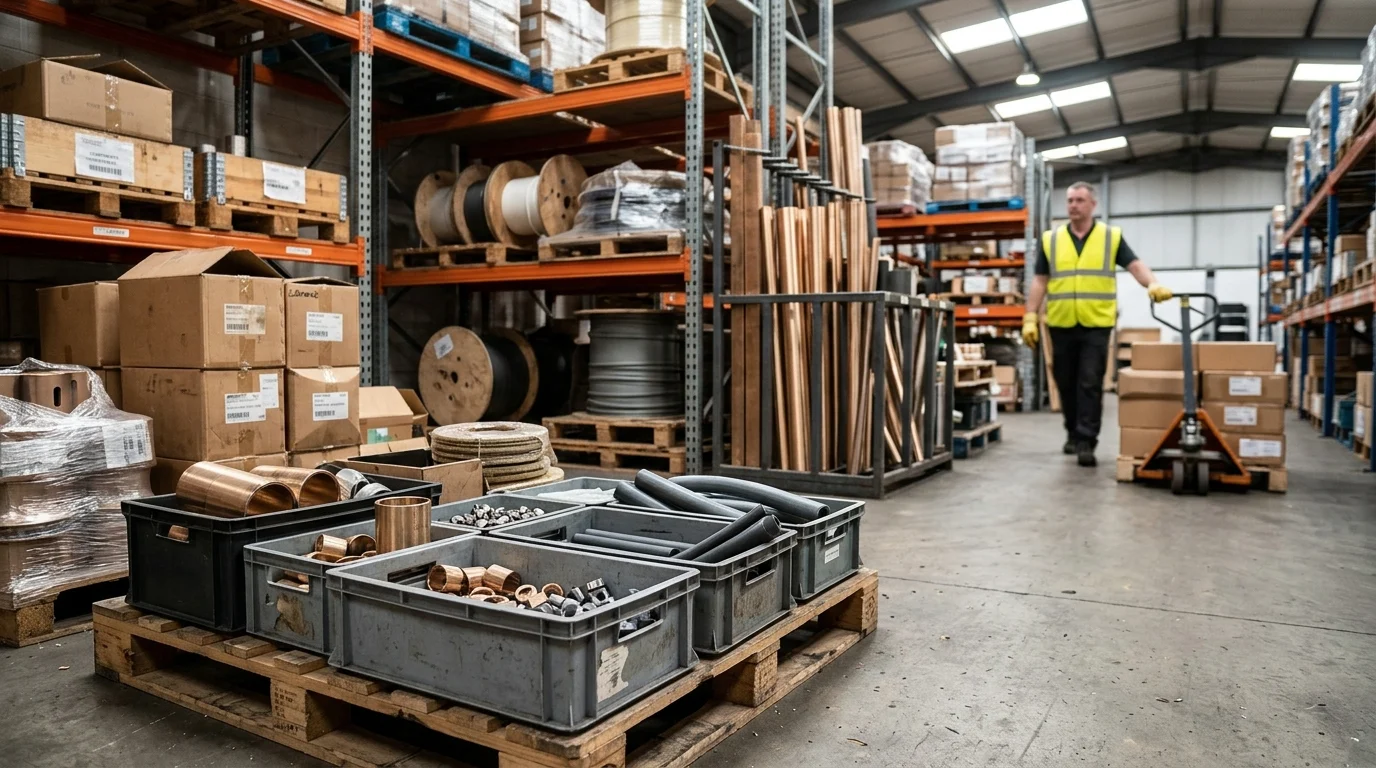
The performance of a self-lubricating bearing is fundamentally dictated by its tribological system. Engineers must evaluate the base matrix and the embedded lubricant to ensure compatibility with the application’s mechanical and thermal demands.
Common material systems and how they work
Modern self-lubricating bearings typically fall into three material categories: polymer-lined metal-backed composites, sintered powder metals, and engineered solid plastics. Metal-backed composites often feature a steel or bronze shell with a sintered porous bronze inner layer impregnated with PTFE (Polytetrafluoroethylene) and specialized wear additives.
Sintered powder metal bearings rely on a porous bronze or iron matrix holding 15% to 30% oil by volume, which is drawn to the surface via capillary action during operation. Engineered solid plastics, such as PEEK or POM, blend base resins with solid micro-lubricants like graphite, MoS2, or silicone to form a homogenous, wear-resistant structure.
Key operating limits: load, speed, PV, temperature, contamination
Operating limits dictate material viability, primarily governed by the PV factor (Pressure × Velocity). Exceeding the PV limit induces thermal runaway and rapid wear.
| Material Type | Max Dynamic Load (MPa) | Max Speed (m/s) | Max PV Limit (MPa·m/s) | Max Temp (°C) |
|---|---|---|---|---|
| PTFE-Lined Composite | 140 | 2.0 | 1.8 | 250 |
| Sintered Bronze (Oil) | 10 | 6.0 | 1.6 | 90 |
| Engineered POM | 70 | 2.5 | 3.0 | 110 |
| Solid PEEK Composite | 120 | 1.5 | 3.5 | 250 |
Engineers must also account for ambient contamination. While solid polymers embed particulate matter effectively to protect the shaft, metal-backed PTFE bearings can suffer accelerated wear if abrasive dust compromises the thin 0.01 mm to 0.03 mm sliding layer.
Surface and shaft-finish considerations
The counter-surface, typically a steel shaft, acts as the other half of the tribological pair. For optimal wear life, the shaft hardness should generally exceed 50 HRC, particularly when paired with glass-fiber-reinforced polymers or hard sintered metals.
Surface finish is equally critical; a roughness (Ra) between 0.2 µm and 0.4 µm is ideal. Finishes smoother than 0.1 µm prevent the necessary transfer film from adhering to the shaft, while finishes rougher than 0.8 µm act as a microscopic file, rapidly machining away the bearing’s lubricating layer.
How to compare them with alternatives
Selecting a self-lubricating bearing requires a rigorous comparative analysis against conventional rolling-element bearings and manually greased bronze bushings. The decision hinges on kinematic constraints, space limitations, and frictional tolerances.
How to evaluate wear life, friction, and misalignment
Wear life in dry-running bearings is predictable using manufacturer-specific wear factors (k-factors), contrasting with the L10 fatigue life calculations used for rolling bearings. Friction coefficients for self-lubricating types typically range from 0.03 to 0.20, which is higher than the 0.001 to 0.005 range of deep-groove ball bearings.
However, self-lubricating spherical plain bearings excel in handling misalignment. They routinely accommodate 2 to 3 degrees of static misalignment without the edge-loading penalties that critically damage rigid needle or cylindrical roller bearings.
When they outperform rolling bearings, bushings, or greased designs
Self-lubricating plain bearings decisively outperform rolling-element designs in high-load, low-speed, and oscillating applications. When an application involves oscillation angles of less than 45 degrees, rolling bearings are highly susceptible to false brinelling—a phenomenon where rollers fail to distribute grease, causing localized fretting wear.
Furthermore, in space-constrained assemblies, a composite plain bearing with a wall thickness of merely 1.0 mm to 2.5 mm frees up substantial radial footprint compared to bulky caged roller assemblies, offering a vastly superior strength-to-weight ratio.
How to select and validate a bearing
Transitioning from theoretical selection to physical integration demands a structured validation process. Engineers must rigorously screen application parameters and execute targeted testing to prevent premature field failures.
How to screen the application data
Screening application data requires moving beyond nominal operating conditions to capture peak transient states. Engineers must document the maximum edge loads, shock loads—which can instantaneously multiply nominal loads by factors of 3 to 5—and the precise duty cycle.
A bearing operating continuously at a PV factor of 1.0 MPa·m/s will exhibit vastly different thermal equilibrium characteristics than one operating at the same PV factor but with a 10% duty cycle, as the latter allows for critical heat dissipation between movements.
Qualification steps, supplier questions, and test protocols
Qualification involves stringent supplier audits and accelerated life testing. Buyers should demand statistical process control data, ensuring critical dimensions like the inner diameter maintain a Process Capability Index (Cpk) greater than 1.33.
| Test Protocol | Objective | Key Metric Evaluated |
|---|---|---|
| Accelerated Wear Test | Simulate 5-year life under continuous load | Radial clearance increase (max allowable typically 0.1 mm) |
| Thermal Cycling | Verify dimensional stability across extremes | Interference fit retention at -40°C to +120°C |
| Salt Spray (ASTM B117) | Assess corrosion resistance of metal backing | Hours to first red rust (e.g., >400 hours) |
Standardizing these protocols ensures that the bearing will perform reliably across different production batches and environmental extremes.
Failure modes to check before release
Before final release, design teams must evaluate susceptibility to specific failure modes. Thermal runaway occurs if the PV limit is exceeded without adequate heat sinking, leading to polymer melting or catastrophic seizure.
Cold flow, or creep, is a distinct risk for solid thermoplastic bearings subjected to static loads exceeding 30 to 40 MPa over extended durations. Finally, abrasive third-body wear must be checked; if the application environment introduces silica or metal shavings, proper wiper seals must be specified to protect the bearing interface.
How to balance cost, compliance, and lifecycle risk

Beyond technical specifications, procurement and engineering teams must align on the commercial realities of self-lubricating bearings. Balancing piece-part cost against lifecycle benefits requires a comprehensive total cost of ownership (TCO) approach.
Main cost drivers, lead times, and quality controls
The upfront piece price of a self-lubricating bearing is often 1.5 to 3 times higher than a standard cast bronze bushing. Cost drivers include the complexity of the polymer matrix, proprietary filler materials, and manufacturing methods.
Standard wrapped composite bushings have low minimum order quantities (MOQs) of 100 to 500 pieces and lead times of 2 to 4 weeks. In contrast, custom injection-molded solid polymer bearings incur tooling costs ranging from $2,000 to $8,000, demanding MOQs of 5,000+ units to amortize the mold investment, with lead times stretching to 8 to 12 weeks. Quality controls, such as ultrasonic testing for delamination in metal-backed variants, also add marginal costs but mitigate catastrophic risks.
How to build a simple lifecycle decision framework
Building a lifecycle decision framework requires quantifying the hidden costs of traditional lubrication. A robust TCO model calculates the initial bearing cost, the cost of the automated lubrication system or manual labor (e.g., $40 per hour for 2 hours monthly over a 5-year lifespan), the cost of the grease itself, and the financial impact of expected downtime.
When a $5 greased bushing requires $1,500 in maintenance labor and grease over five years, a $15 self-lubricating bearing that requires zero maintenance yields an overwhelming commercial advantage, fundamentally derisking the machinery’s operational lifecycle.
Key Takeaways
- The most important conclusions and rationale for self-lubricating bearings
- Specs, compliance, and risk checks worth validating before you commit
- Practical next steps and caveats readers can apply immediately
Frequently Asked Questions
When should I choose a self-lubricating bearing over a grease-lubricated one?
Choose it when relubrication is difficult, downtime is costly, or leaks are unacceptable. It works well in dusty, cleanroom, or hard-to-access applications.
What material should I select for my application?
Match the material to load, speed, and temperature. PTFE-lined composites suit high load, POM handles moderate load and speed, and PEEK fits higher temperature or stronger wear demands.
How do I check if the bearing will handle my operating conditions?
Compare your load and speed to the bearing’s PV limit, plus its max temperature rating. If contamination is high, prefer a material that tolerates dust and debris better.
What shaft finish is best for self-lubricating bearings?
Use a shaft hardness above 50 HRC and a surface roughness around Ra 0.2–0.4 µm. Too smooth or too rough can reduce life.
Can self-lubricating bearings replace all conventional bearings?
No. They are best for dry or low-maintenance use. For very high speeds, extreme shock loads, or precision rolling needs, conventional bearings may perform better.
Post time: May-14-2026