Why Industrial Roller Chain Selection Matters for Procurement
Procuring industrial roller chains requires balancing aggressive cost targets with uncompromising mechanical reliability. For wholesale buyers, distributors, and original equipment manufacturers (OEMs), roller chains are critical power transmission components where failure directly equates to halted production lines and severe financial losses. Unlike consumer-grade hardware, industrial roller chains operate under continuous dynamic loads, abrasive environments, and extreme temperature fluctuations, demanding a highly structured approach to specification and sourcing.
Strategic procurement in this category shifts the focus from simple unit cost reduction to total cost of ownership (TCO). This involves a deep understanding of metallurgical properties, regional manufacturing capabilities, and the global supply chain dynamics that dictate lead times and availability. Establishing a rigorous selection framework ensures that buyers can confidently navigate the vast landscape of global manufacturers while mitigating the inherent risks of cross-border sourcing.
Defining B2B roller chain requirements
Defining B2B roller chain requirements begins with standardizing the dimensional and structural parameters according to international norms, primarily ANSI B29.1 or ISO 606 (DIN 8187/8188). Procurement teams must specify the exact pitch, roller diameter, and inner width, as these dictate compatibility with existing sprockets and drive systems. Beyond physical dimensions, buyers must define the required fatigue strength and maximum working load limits based on the application’s torque and speed profiles.
Furthermore, requirements must encompass the environmental operating conditions. Chains destined for food processing or corrosive chemical applications necessitate 304 or 316 stainless steel, or specialized protective coatings like nickel or zinc plating. Conversely, heavy-duty mining or agricultural applications might require standard carbon steel chains with enhanced O-ring or X-ring seals to retain lubrication and block abrasive particulates. Clearly documenting these parameters in a comprehensive Request for Quotation (RFQ) prevents supplier misinterpretation and ensures accurate baseline pricing.
Commercial risks of poor specification
The commercial risks associated with poor roller chain specification extend far beyond the replacement cost of the chain itself. In a high-volume manufacturing environment, such as an automotive assembly line, unexpected chain breakage can result in downtime costs exceeding $10,000 per hour. Premature elongation—where a chain stretches beyond the acceptable 3% threshold due to inadequate pin and bushing hardness—causes sprocket wear, leading to a cascading failure of the entire drive mechanism.
Additionally, sourcing sub-standard chains introduces severe liability and warranty risks for OEMs and distributors. If a distributor supplies a batch of chains that fail to meet the advertised tensile strength, the resulting product recalls and brand damage can be catastrophic. By prioritizing stringent specification protocols and insisting on verified mechanical testing, procurement teams shield their organizations from these hidden, yet highly probable, commercial liabilities.
Technical Criteria for Comparing Industrial Roller Chain
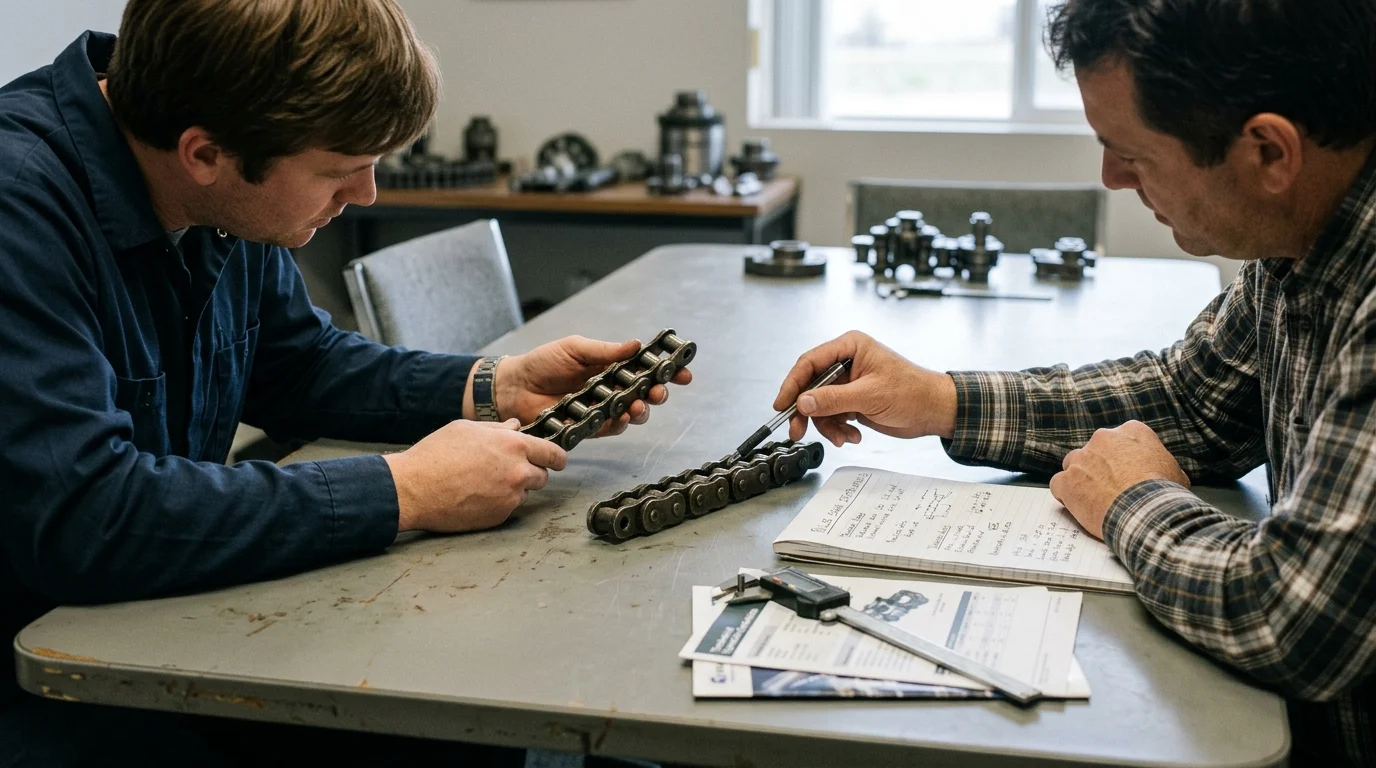
Evaluating industrial roller chains requires moving past marketing claims and analyzing the core engineering data. Buyers must compare technical criteria across multiple suppliers to ensure the physical product meets the rigorous demands of industrial power transmission. This technical assessment forms the foundation of any vendor qualification process, separating tier-one manufacturers from lower-quality producers.
Core dimensions and performance metrics
The fundamental metrics for any roller chain are its core dimensions—pitch, roller diameter, and width between inner plates. However, performance is dictated by the Ultimate Tensile Strength (UTS) and the Maximum Allowable Working Load (MAWL). For instance, a standard ANSI 60 chain has a pitch of 0.750 inches and must meet a minimum tensile strength of 7,030 lbs. Procurement teams must request certified test reports to verify that a supplier’s chain consistently meets or exceeds these baseline figures.
Another critical metric is fatigue strength, which measures the chain’s ability to withstand repeated cyclic loading without failure. High-quality manufacturers improve fatigue strength by utilizing wider link plates or optimizing the plate profile. Buyers should also evaluate the chain’s elongation rate over time; premium chains are typically pre-stretched (pre-loaded) during manufacturing to 30%–50% of their minimum tensile strength, which minimizes initial operational stretch and extends service life.
Materials, heat treatment, lubrication, and corrosion resistance
Material selection and heat treatment are the primary drivers of roller chain durability. Standard industrial chains are typically forged from high-carbon steel or alloy steel. The pins and bushings, which bear the brunt of frictional wear, must undergo precise case hardening or carbonitriding to achieve a surface hardness of 50–60 HRC while maintaining a tough, ductile core to absorb shock loads. Inconsistent heat treatment is a common flaw in low-cost chains, leading to brittle components that shatter under stress.
Lubrication and corrosion resistance are equally vital. Factory-applied lubrication must penetrate the micro-clearances between pins and bushings. Advanced suppliers vacuum-impregnate chains with high-viscosity, anti-wear grease. For corrosive environments, procurement teams must evaluate the efficacy of protective finishes. While standard shot peening improves fatigue resistance, applications exposed to moisture may require dacromet coating, nickel plating, or a shift to martensitic stainless steel, each carrying distinct price premiums and load capacity trade-offs.
Procurement comparison table and benchmarks
To streamline supplier evaluation, procurement teams should utilize benchmark tables that align standard sizes with expected performance metrics. This allows buyers to instantly spot discrepancies in a supplier’s technical proposal.
| ANSI Chain Size | Pitch (inches) | Min. Tensile Strength (lbs) | Roller Diameter (in) | Typical Application |
|---|---|---|---|---|
| 40 | 0.500 | 3,125 | 0.312 | Light conveyors, packaging machinery |
| 60 | 0.750 | 7,030 | 0.469 | Medium agricultural equipment, textiles |
| 80 | 1.000 | 12,500 | 0.625 | Heavy-duty drives, mining, automotive |
| 100 | 1.250 | 19,500 | 0.750 | High-load industrial hoists, lumber mills |
By standardizing these metrics across all RFQs, buyers can accurately normalize bids and ensure that cost comparisons are based on identical structural capabilities rather than deceptive downgrades in material quality.
How to Assess Industrial Roller Chain Suppliers
Identifying a manufacturer capable of producing a high-quality roller chain is only half the sourcing equation; assessing their operational reliability, capacity, and commercial flexibility is equally critical. For B2B buyers, the supplier evaluation process must probe deeply into factory floor operations, quality management systems, and the commercial terms that dictate inventory flow.
Factory qualifications, production controls, and testing
A rigorous assessment begins with verifying factory qualifications. A baseline requirement is ISO 9001 certification, but buyers sourcing for critical applications should look for ISO/TS16949 (or IATF 16949) compliance. Originally developed for the automotive sector, this standard signifies advanced statistical process control (SPC), rigorous defect tracking, and superior traceability—qualities essential for high-end industrial bearings and roller chains alike.
During factory audits, buyers must evaluate the production controls and testing infrastructure. Key indicators of a capable supplier include automated assembly lines, in-house metallurgical labs for analyzing steel composition, and dedicated fatigue testing rigs. Suppliers should routinely perform destructive testing on sample batches to verify ultimate tensile strength and hardness. Lack of in-house testing equipment often indicates a mere assembler rather than a primary manufacturer, increasing the risk of inconsistent batch quality.
MOQ, customization, packaging, and labeling
Commercial terms such as Minimum Order Quantities (MOQ) significantly impact a distributor’s inventory carrying costs. Standard MOQs for industrial roller chains often range from 1,000 to 3,000 meters per size, or 500 individual 10-foot boxes. Buyers must negotiate these thresholds based on their demand forecasting, potentially leveraging higher total annual volumes to secure lower per-SKU MOQs.
Customization and packaging capabilities are also vital for distributors and OEMs. This includes the ability to integrate custom attachments (e.g., A1, K1, or extended pins) directly on the production line. Furthermore, private labeling, custom box printing, and specific color-coding of outer cartons are essential for distributors building their own brand equity. Assessing a supplier’s willingness and technological capability to accommodate these packaging requirements without excessive lead time penalties is a key step in the vetting process.
Sourcing steps to reduce quality and delivery risk
Mitigating quality and delivery risks requires a structured, multi-step sourcing protocol. It begins with ordering and rigorously testing pre-production samples. Once approved, the first mass production run should be subjected to third-party inspection before shipment. Utilizing Acceptable Quality Limit (AQL) standards—typically setting critical defects at 0, major defects at 1.5, and minor defects at 4.0—ensures the batch meets expectations before the balance payment is released.
To reduce delivery risk, buyers should evaluate the supplier’s raw material sourcing network. Manufacturers who maintain localized stockpiles of high-carbon steel are less susceptible to global commodity shocks. Additionally, establishing clear penalty clauses for delayed shipments in the purchasing contract incentivizes the supplier to prioritize your production schedule during peak manufacturing seasons.
Trade, Compliance, and Logistics Considerations
Global sourcing of industrial roller chains involves navigating complex trade regulations, stringent compliance standards, and volatile logistics networks. For importers and wholesale distributors, mastering these elements is essential to prevent costly customs delays, protect inventory from environmental damage during transit, and accurately calculate the true cost of procurement.
Required documentation, standards, and compliance checks
Importing industrial components requires meticulous documentation to satisfy both customs authorities and domestic industry standards. Critical required documents include commercial invoices, packing lists, Bills of Lading (B/L), and Certificates of Origin (CoO). For technical compliance, buyers must demand Mill Test Reports (MTR) from the supplier, which certify the chemical composition and mechanical properties of the steel used in the specific batch.
Depending on the end-use and regional regulations, additional compliance checks may be necessary. Chains utilized in food processing or pharmaceutical environments must comply with FDA regulations regarding food-grade lubricants. Furthermore, buyers importing into the European Union must ensure compliance with REACH and RoHS directives, confirming that protective platings (like certain older zinc-chromate finishes) do not contain restricted heavy metals such as hexavalent chromium.
Packaging, rust prevention, palletization, and lead times
Because industrial roller chains are highly susceptible to oxidation during extended ocean freight, packaging and rust prevention are critical logistical considerations. High-quality suppliers utilize Vapor Corrosion Inhibitor (VCI) bags inside heavy-duty corrugated boxes. The chains themselves should be coated with a specialized anti-rust oil that provides up to 12 months of protection without degrading the internal lubrication.
Palletization must adhere to international shipping standards. Wooden pallets and crates must be ISPM 15 certified and stamped to prove they have been heat-treated to prevent pest infestation. Failure to comply can result in entire shipments being quarantined or destroyed at the port of entry. Lead times also require careful planning; standard production cycles for roller chains typically span 30 to 45 days, combined with ocean transit times of 25 to 40 days, necessitating a robust 90-day procurement forecast.
Total cost comparison for distributors
Distributors must look beyond the Ex-Works (EXW) or Free on Board (FOB) price to understand the Total Landed Cost. This calculation includes ocean freight, marine insurance, port handling fees, domestic drayage, and import tariffs. For example, roller chains imported into the United States from certain origins may be subject to Section 301 tariffs, which can add up to 25% to the commercial value of the goods.
| Cost Component | Typical Share of Landed Cost | Key Variables & Optimization Strategies |
|---|---|---|
| Ex-Works Unit Price | 60% – 70% | Raw steel index, heat treatment depth, negotiated MOQ |
| Ocean Freight | 10% – 15% | FCL vs LCL utilization, seasonal container rate fluctuations |
| Tariffs & Duties | 5% – 25% | HS code classification (e.g., 7315.11), country of origin, trade agreements |
| Port Fees & Domestic Logistics | 5% – 10% | Pallet weight, warehouse proximity, drayage availability |
By building a dynamic landed cost model, procurement professionals can accurately compare quotes from suppliers in different geographic regions, ensuring that a lower unit price is not negated by exorbitant freight or tariff penalties.
Building a Reliable Industrial Roller Chain Sourcing Strategy
A successful industrial roller chain sourcing strategy transcends individual transactions; it requires building resilient, long-term partnerships that drive continuous value. By synthesizing technical specifications, supplier capabilities, and logistical realities, procurement leaders can construct a framework that stabilizes costs and guarantees supply chain continuity even amid global market volatility.
Decision model for supplier comparison
Developing a
Key Takeaways
- Wholesale sourcing and supply-chain implications for Industrial Roller
- Specifications, compliance, and commercial terms buyers should validate
- Actionable recommendations for distributors and procurement teams
Frequently Asked Questions
How do I choose the right industrial roller chain size?
Match chain pitch, roller diameter, and inner width to your existing sprockets, using ANSI B29.1 or ISO 606 dimensions. Verify working load and speed before ordering.
Which material is best for corrosive or washdown environments?
Use 304 or 316 stainless steel for corrosion resistance. For milder exposure, consider carbon steel chains with zinc or nickel plating to balance cost and protection.
Why is certified testing important when buying roller chains?
Certified tensile, hardness, and elongation reports confirm the chain meets stated performance. This helps OEMs and distributors reduce downtime, warranty claims, and premature sprocket wear.
What chain features help extend service life in dusty or heavy-load applications?
Choose hardened pins and bushings, proper heat treatment, and sealed designs such as O-ring or X-ring chains. These features retain lubricant and block abrasive contaminants.
Can DEMY support industrial buyers beyond the product itself?
Yes. DEMY’s catalog-driven industrial site provides product information, FAQs, videos, and company support, helping buyers compare specifications and source reliable transmission-related components more efficiently.
Post time: Apr-16-2026