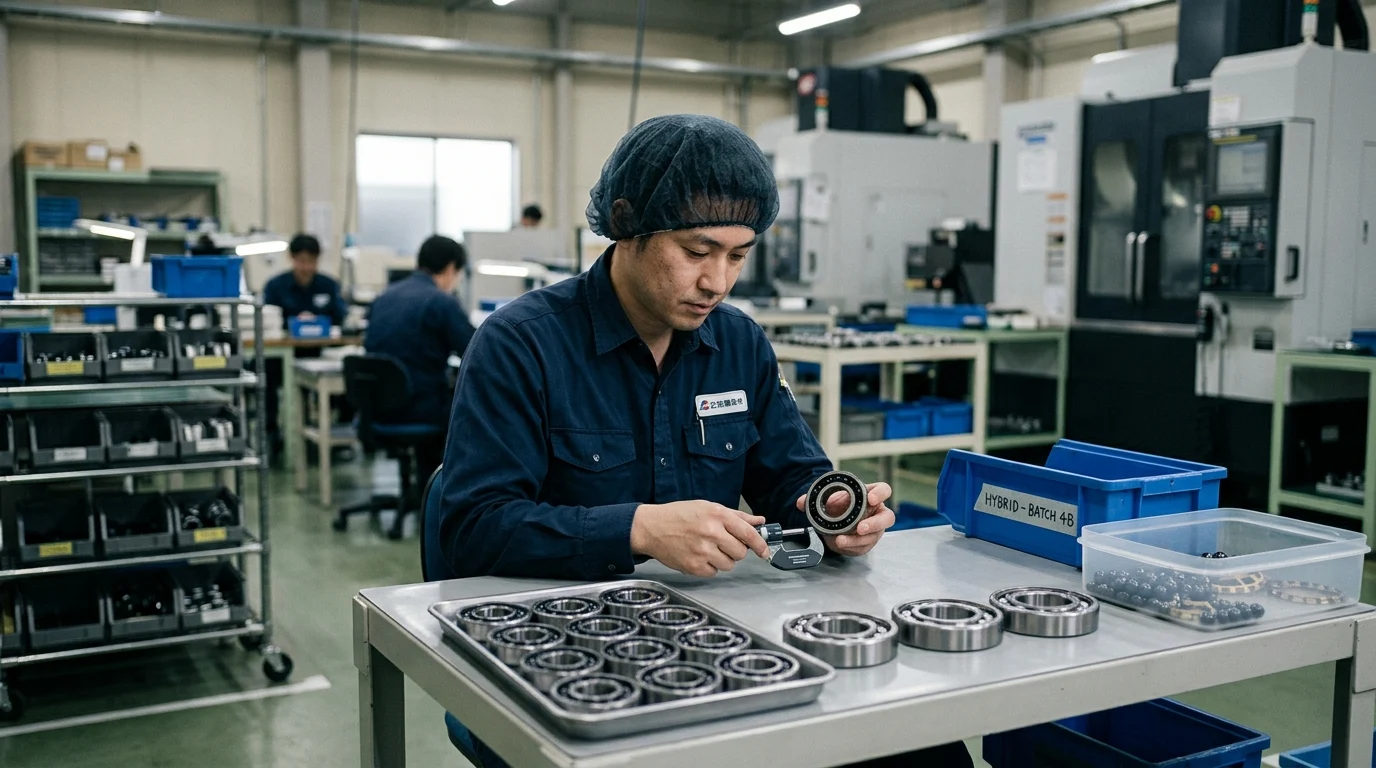
Furthermore, the global bearing market is highly segmented, requiring buyers to match material specifications with precise industry standards. Whether sourcing for harsh chemical environments, high-speed electric motors, or heavy-duty agricultural equipment, understanding the distinct advantages and limitations of each material is essential for optimizing procurement budgets and ensuring regulatory compliance.
Impact on total cost of ownership
The Total Cost of Ownership (TCO) for ball bearings extends far beyond the initial purchase price. While standard steel bearings offer low upfront costs, deploying them in highly corrosive or electrically charged environments can result in frequent replacements and costly machine downtime. Conversely, investing in premium ceramic or hybrid bearings may yield a higher initial invoice but significantly lower the TCO by extending maintenance intervals, reducing lubrication requirements, and minimizing unexpected operational halts.
Buyer segments and application needs
Different industrial sectors possess distinct operational parameters that dictate bearing material selection. Aerospace and medical device manufacturers often require the lightweight and non-magnetic properties of full ceramic bearings. Meanwhile, OEM bearing supplier for automotive industry procurement teams will predominantly focus on high-grade chrome steel or hybrid options to balance load capacity, speed, and cost-efficiency in drivetrain and wheel hub applications.
Commercial risks of wrong material selection
Failing to specify the correct bearing material introduces severe commercial risks, including warranty claims, product recalls, and contract penalties due to missed delivery schedules. If a distributor supplies standard steel bearings to a client operating in a high-moisture food processing plant, the resulting rust and premature failure will erode client trust and margin profitability. Rigorous material vetting is therefore a critical risk mitigation strategy.
Steel vs Ceramic vs Hybrid Ball Bearings
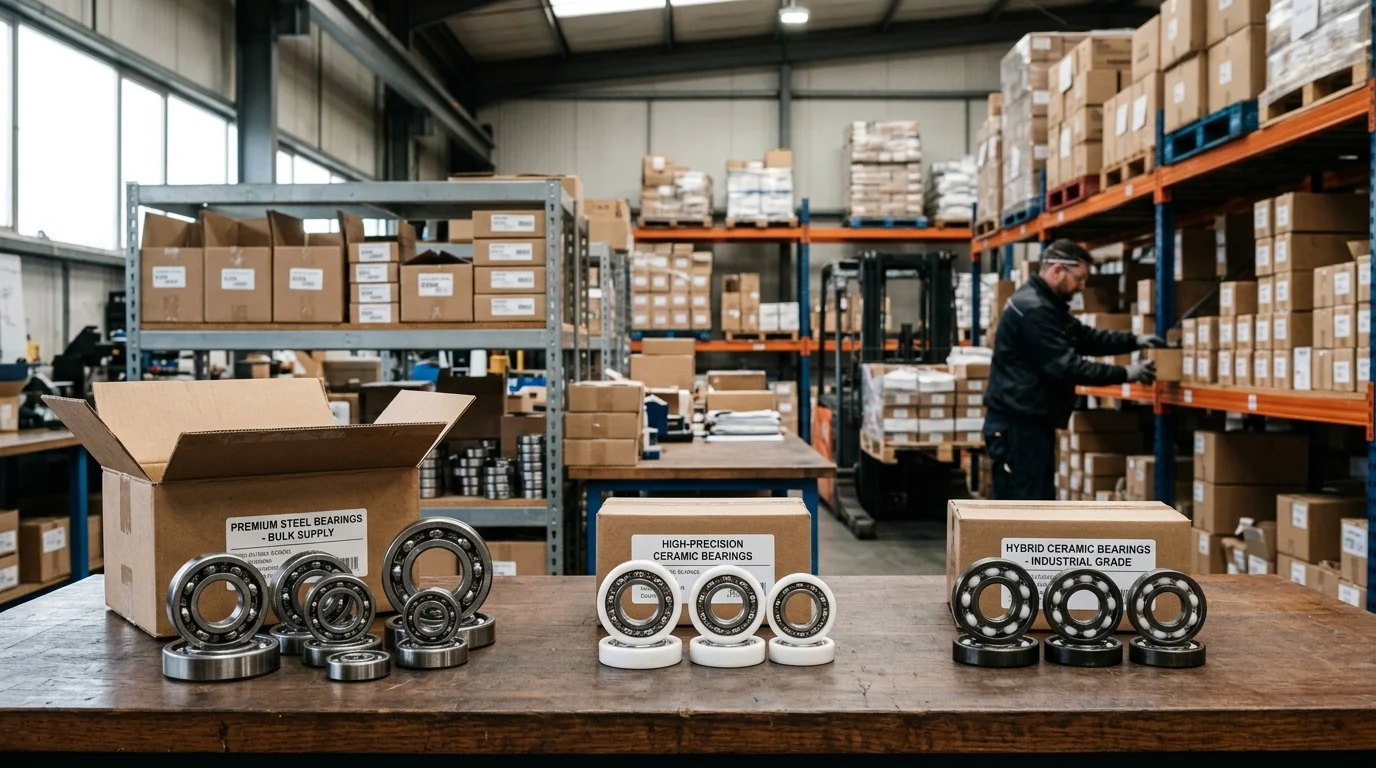
The industrial ball bearing market is primarily categorized into three material classifications: traditional steel, full ceramic, and hybrid configurations. Each category offers a unique profile of tensile strength, thermal expansion, and friction coefficients. Understanding these core differences is the first step in developing a robust sourcing strategy.
Steel remains the undisputed industry standard due to its versatile performance and cost-effectiveness at scale. However, as industrial machinery pushes the boundaries of speed, temperature, and electrical efficiency, alternative materials have gained significant market share. Ceramic and hybrid variants are increasingly specified in advanced engineering applications where steel’s physical limitations become a liability.
Procurement teams must evaluate these three categories not just on technical merits, but on supply chain availability, lead times, and minimum order quantities. While steel bearings are globally commoditized and readily available, specialized ceramic and hybrid bearings often require longer manufacturing lead times and specialized vendor relationships.
Steel bearing construction and specifications
The vast majority of industrial ball bearings are manufactured from SAE 52100 chrome steel, prized for its excellent hardness and high load-bearing capacity. For environments requiring moisture resistance, buyers typically seek a stainless steel bearings supplier bulk partner to procure AISI 440C or 304/316 grade stainless bearings. While stainless steel provides superior corrosion resistance, it generally supports lower dynamic loads compared to standard chrome steel.
Ceramic bearing characteristics and trade-offs
Full ceramic bearings are typically constructed from Silicon Nitride (Si3N4) or Zirconia (ZrO2). These materials are non-magnetic, highly resistant to extreme temperatures, and impervious to most corrosive chemicals. Furthermore, ceramic balls are significantly lighter and harder than steel, allowing for higher operational speeds. The primary trade-offs are their brittleness, making them susceptible to shock loads, and their exceptionally high manufacturing costs.
Hybrid bearing design and use cases
Hybrid ball bearings combine the best of both worlds, utilizing traditional steel inner and outer rings paired with ceramic rolling elements (usually Si3N4). This configuration is particularly dominant in electric motor applications and wind turbines, as the ceramic balls provide natural electrical insulation, preventing electrical arcing that causes pitting and premature failure in standard steel bearings. Hybrids also run cooler and require less lubrication than all-steel counterparts.
Performance Comparison for B2B Buyers
To make informed purchasing decisions, buyers must transition from qualitative descriptions to quantitative performance metrics. Comparing steel, ceramic, and hybrid bearings involves analyzing operational thresholds such as maximum Revolutions Per Minute (RPM), thermal expansion rates, and dynamic load ratings.
The table below illustrates a generalized comparison of these three bearing types to assist procurement teams in aligning component capabilities with engineering requirements.
| Bearing Material | Relative Speed Limit | Load Capacity (Shock) | Electrical Insulation | Cost Profile |
|---|---|---|---|---|
| Chrome Steel | Baseline | High | None | Low |
| Full Ceramic | Very High | Low (Brittle) | Excellent | Very High |
| Hybrid | High | Moderate-High | Excellent | Moderate |
By mapping these performance indicators against the intended application, buyers can optimize their procurement spend. It is crucial to remember that over-specifying a bearing (e.g., buying full ceramic for a low-speed, standard-temperature application) wastes capital, while under-specifying leads to catastrophic failure.
Load, speed, temperature, and wear
Steel bearings excel under heavy, continuous loads and absorb shock effectively due to their metallurgical elasticity. However, at extreme speeds, steel balls generate significant centrifugal force and friction heat. Ceramic balls, being up to 40% less dense than steel, generate less centrifugal force, allowing hybrid and full ceramic bearings to achieve 30-50% higher RPMs with reduced wear and lower operating temperatures.
Lubrication, maintenance, and contamination resistance
Lubrication degradation is a leading cause of bearing failure. Ceramic materials have a lower coefficient of friction and do not micro-weld to steel raceways when lubrication is starved. Consequently, hybrid and ceramic bearings can operate efficiently with marginal lubrication. Furthermore, full ceramic bearings are immune to rust, making them ideal for sterile or highly contaminated washdown environments.
When higher unit cost lowers lifecycle cost
Procurement teams must calculate ROI over the equipment’s lifespan. While a hybrid bearing may cost three to five times more than a standard steel equivalent, its ability to prevent electrical erosion in variable frequency drive (VFD) motors can save thousands of dollars in motor repair and factory downtime, making the higher unit cost a sound financial investment.
Key Specifications to Confirm Before Ordering
Once the material is selected, buyers must define the exact dimensional and operational specifications to generate an accurate Request for Quotation (RFQ). Bearings are precision-engineered components, and a discrepancy of a few micrometers can render a batch entirely unusable for the intended assembly.
Standardization bodies such as the International Organization for Standardization (ISO) and the American Bearing Manufacturers Association (ABMA) provide the frameworks used to specify bearing tolerances and clearances. B2B buyers must clearly communicate these specifications to their manufacturing partners to ensure cross-border compliance and functional compatibility.
In addition to dimensional accuracy, buyers must specify secondary components such as cages (retainers), seals, and factory-applied lubrication. These secondary elements often determine the bearing’s success in specific environments, such as high-dust agricultural settings or high-temperature industrial ovens.
Dimensions, clearance, precision, and seals
A standard RFQ must detail the inner diameter, outer diameter, and width. Buyers must also specify the precision class (e.g., ABEC 1 through ABEC 9) and internal radial clearance (e.g., C3 or C4 for high-temperature applications). Seal configurations are equally critical; buyers must choose between open, metal-shielded (ZZ), or rubber-sealed (2RS) variants depending on the contamination risk.
Operating conditions and environment
Suppliers need detailed context regarding the bearing’s operating environment. Procurement documents should state the expected ambient and operating temperatures, presence of aggressive chemicals, moisture levels, and the anticipated RPM and load profiles. This information allows the manufacturer to recommend the correct grease fill percentage and base oil viscosity.
OEM and private label customization points
Many distributors require proprietary branding and specialized dimensions. Sourcing custom bearings involves specifying laser-engraved logos on the outer rings, custom-colored rubber seals for brand identity, and non-standard dimensional modifications to fit proprietary OEM equipment designs.
How to Source Ball Bearings from Manufacturers
Navigating the global ball bearing supply chain requires rigorous vendor vetting and strategic negotiation. The market is populated by massive multinational corporations, specialized boutique manufacturers, and trading companies. Buyers must identify the right tier of supplier that matches their volume requirements and quality standards.
Effective sourcing involves auditing the factory’s production capabilities, quality control infrastructure, and financial stability. Buyers should request comprehensive capability statements, machine lists, and evidence of raw material sourcing to ensure the factory is not substituting inferior steel or ceramic compounds to cut costs.
Furthermore, commercial terms such as production lead times, payment terms, and packaging requirements must be negotiated upfront. Clear communication regarding these logistical and commercial parameters prevents costly delays and ensures the product arrives ready for integration or distribution.
Factory capability, MOQ, and lead times
Partnering with a high precision ball bearings factory often requires navigating Minimum Order Quantities (MOQs). Standard steel bearings might have MOQs in the thousands, while specialized hybrid or custom bearings may have lower MOQs but longer lead times (often 60-90 days) due to the complexity of sourcing high-grade ceramic balls and custom tooling.
Packaging and labeling for distribution
Packaging impacts both logistics costs and product integrity. B2B buyers must specify whether bearings should be bulk-packed in industrial plastic tubes for OEM assembly lines or individually boxed in branded packaging for aftermarket retail distribution. Additionally, barcode labeling and lot-code stamping are essential for inventory management.
Pricing, margins, and negotiation factors
Securing a bearing factory direct price requires understanding the underlying cost drivers, primarily global steel and ceramic raw material indices. Buyers should negotiate volume-tiered pricing and establish clauses for currency fluctuations and raw material cost adjustments to protect distributor margins over long-term contracts.
Compliance, Quality Assurance, and Logistics Checks
Procuring industrial bearings across international borders introduces significant quality and compliance risks. Without stringent Quality Assurance (QA) protocols, buyers are vulnerable to receiving out-of-spec components or counterfeit products, which are prevalent in the global bearing trade.
Establishing a robust QA framework involves implementing pre-shipment inspections and requiring comprehensive documentation from the supplier. This ensures that every batch of bearings meets the agreed-upon technical specifications and complies with the legal and environmental regulations of the importing country.
Logistics planning is equally critical. Bearings are dense, heavy commodities that are susceptible to rust and impact damage during transit. Proper protective measures must be enforced at the factory level to ensure the cargo survives ocean freight and extended warehouse storage without degradation.
Inspection and testing requirements
Buyers should mandate specific testing protocols before shipment. This includes Rockwell hardness testing for steel rings, noise and vibration testing (e.g., Z1V1 to Z3V3 ratings), and dimensional tolerance checks using coordinate measuring machines (CMM). Acceptable Quality Limit (AQL) standards must be established in the purchase contract.
Documents and standards for import compliance
International procurement requires strict documentation. Suppliers must provide ISO 9001 or IATF 16949 certificates, Mill Test Reports (MTRs) proving raw material chemical composition, and compliance declarations for environmental directives such as RoHS and REACH, particularly if the bearings utilize specialized greases or rubber seals.
Transit protection, traceability, and claims handling
To prevent corrosion during ocean transit, bearings must be coated in rust-preventative oil and sealed in Volatile Corrosion Inhibitor (VCI) paper or bags. Contracts must also outline clear traceability requirements via batch numbers and establish a transparent claims handling process in the event that defective units are discovered upon delivery.
Ball Bearing Supplier Selection Checklist
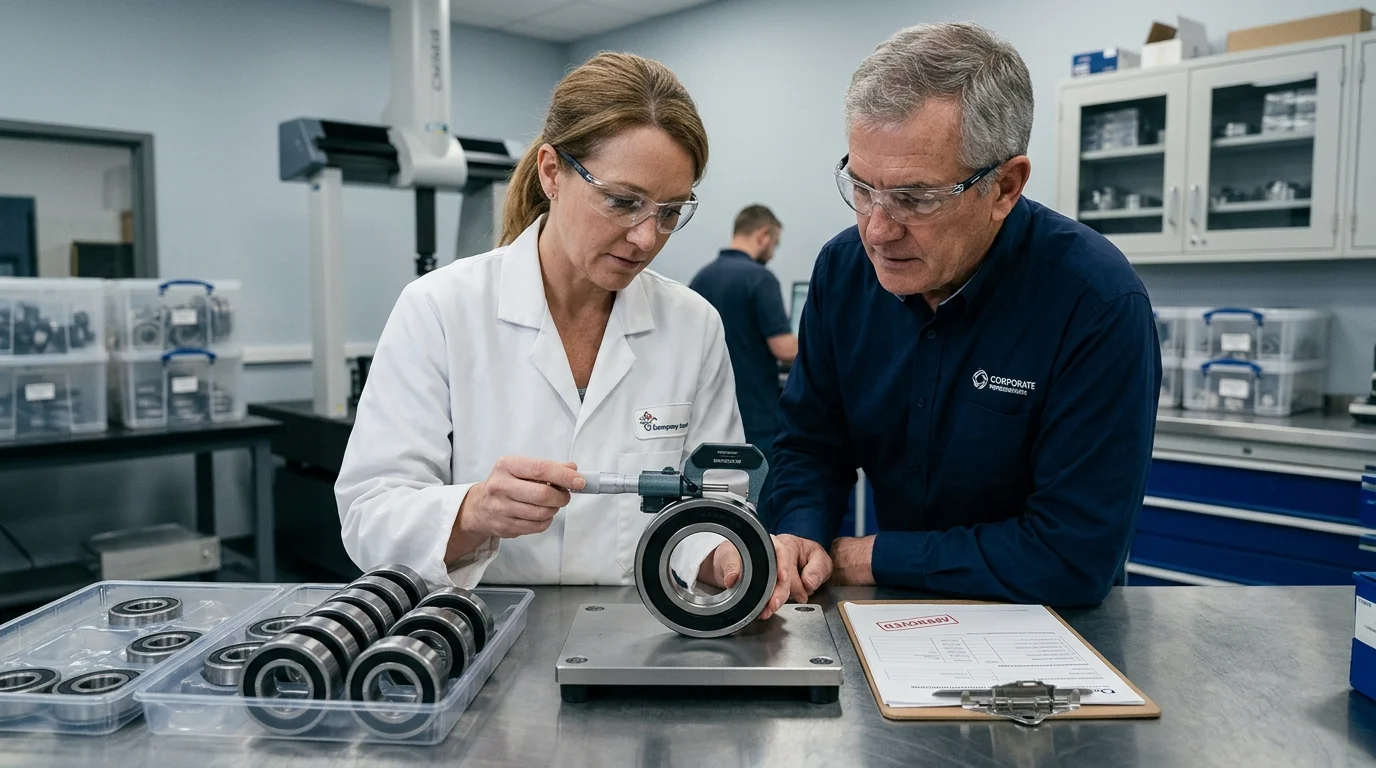
The final stage of procurement involves consolidating all technical, commercial, and logistical data into a structured supplier selection framework. This systematic approach removes subjective bias and ensures the chosen manufacturing partner aligns with the company’s strategic sourcing goals.
A robust checklist helps procurement teams evaluate multiple vendor bids side-by-side, weighing factors such as unit cost against historical quality performance and communication efficiency. This phase often involves cross-functional collaboration between engineering, quality assurance, and purchasing departments.
Ultimately, the goal is to establish a resilient, long-term partnership rather than a transactional purchasing arrangement. Reliable bearing suppliers act as technical consultants, helping B2B buyers optimize their product lines and navigate supply chain disruptions.
Matching material type to risk and budget
The checklist must first confirm that the supplier possesses proven expertise in the required material. A factory excelling in standard steel bearings may lack the cleanroom environments and precision grinding equipment necessary to produce reliable full ceramic or hybrid variants within the allocated budget.
Supplier shortlist criteria
Key criteria for shortlisting include verifiable quality certifications (ISO/IATF), the ability to meet required MOQs, financial health, and a track record of on-time delivery. Requesting reference clients and conducting third-party factory audits are standard practices to validate a supplier’s claims before awarding a contract.
Final decision framework for procurement
The final decision should rely on a weighted scoring matrix that evaluates Total Cost of Ownership, technical capability, lead times, and warranty terms. By systematically applying this framework, B2B buyers can confidently secure a reliable supply of high-quality ball bearings tailored to their specific market demands.
Related reading: custom bearings
Key Takeaways
- Wholesale sourcing and supply-chain implications for ball bearings
- Specifications, compliance, and commercial terms buyers should validate
- Actionable recommendations for distributors and procurement teams