Introduction
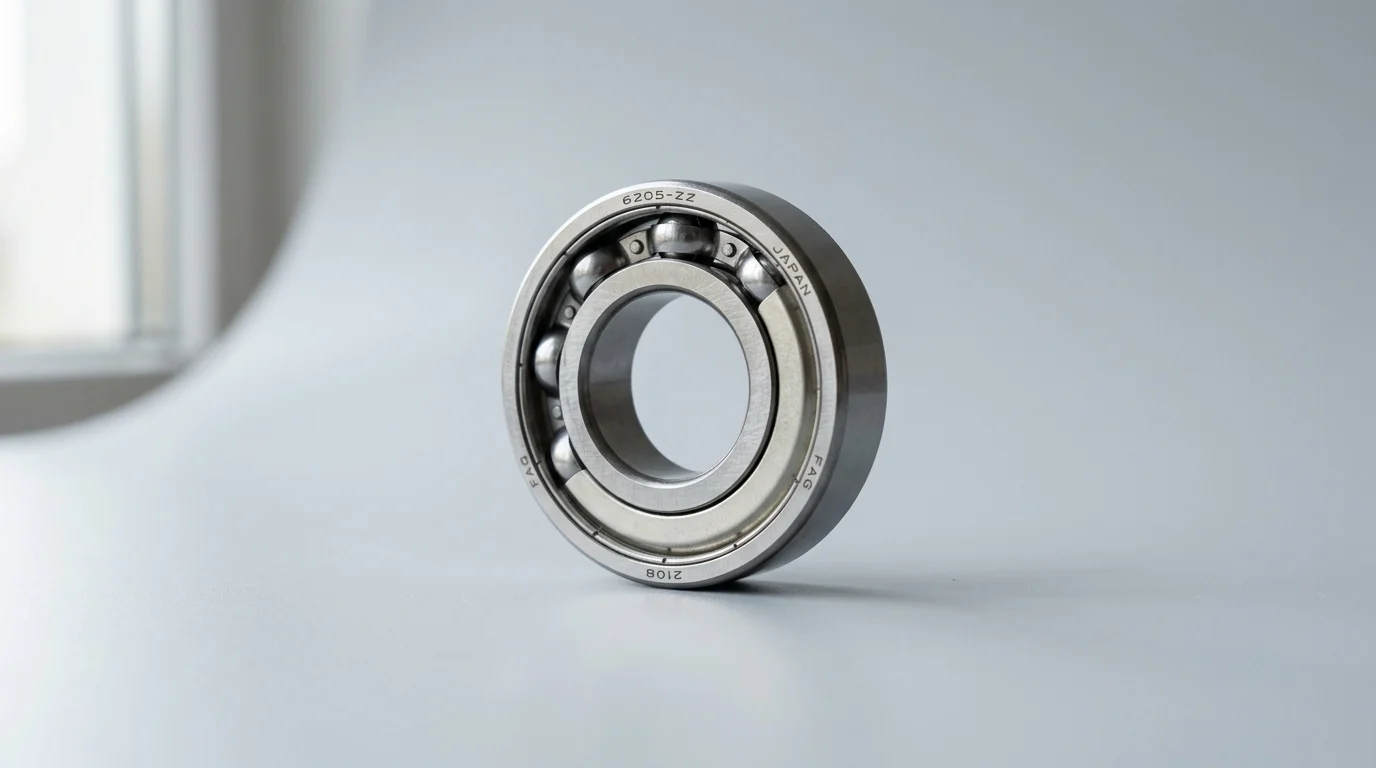
Choosing bearings for an industrial motor affects far more than fit and replacement intervals. The right bearing must handle radial and axial loads, speed, temperature, lubrication conditions, contamination, and, in many cases, electrical current that can damage raceways over time. A poor match can increase vibration, shorten service life, raise energy use, and lead to expensive unplanned shutdowns. This guide explains the main bearing types used in motors, the operating factors that drive selection, and the tradeoffs between performance, durability, and maintenance so you can make more reliable choices for demanding industrial applications.
Why motor bearings selection matters
The specification of motor bearings is a critical engineering decision that dictates the reliability, efficiency, and lifecycle of industrial rotating equipment. Serving as the primary interface between the stationary stator and the rotating shaft, bearings manage dynamic loads while maintaining precise air gaps. In industrial environments where electric motors drive core production processes, selecting the optimal bearing architecture is not merely a maintenance consideration but a fundamental requirement for operational continuity.
Engineers must evaluate a complex matrix of mechanical, thermal, and electrical variables to ensure the selected bearings can withstand continuous duty cycles. Suboptimal selection rapidly accelerates wear mechanisms, leading to premature failure, elevated vibration profiles, and catastrophic motor damage.
Impact on uptime and energy efficiency
The direct correlation between bearing selection and facility uptime cannot be overstated. Unplanned motor failures in heavy continuous process industries, such as petrochemical refining or pulp and paper production, can incur downtime costs ranging from $10,000 to well over $100,000 per hour. Because bearings account for approximately 40% to 50% of all electric motor failures, they are the most vulnerable mechanical component in the drivetrain.
Beyond reliability, bearing selection significantly influences energy consumption. Mechanical friction within the bearing assembly typically accounts for 10% to 15% of the total mechanical losses in a standard electric motor. By specifying low-friction seal designs, optimized internal geometries, and appropriate lubrication viscosities, engineers can minimize rolling resistance. This reduces the motor’s overall energy draw and contributes to facility-wide energy efficiency mandates.
Operating conditions that drive selection
Industrial operating conditions define the baseline requirements for bearing selection. Ambient temperature extremes heavily influence both bearing metallurgy and lubrication strategy. For instance, motors operating in cryogenic environments or high-heat applications near industrial furnaces require specialized greases and heat-stabilized bearing steel capable of maintaining dimensional stability at continuous operating temperatures up to 200°C.
Furthermore, the increasing prevalence of Variable Frequency Drives (VFDs) introduces severe electrical stresses to motor bearings. VFDs generate high-frequency common-mode voltages that can cause electrical arcing through the bearing oil film. This phenomenon, known as electrical discharge machining (EDM), creates micro-craters on the raceways and accelerates grease degradation. Additionally, environments with high particulate contamination or moisture necessitate specialized sealing arrangements, such as labyrinth seals or heavy-duty contact seals, to prevent the ingress of foreign material that would rapidly degrade the rolling elements.
Key specifications and application requirements
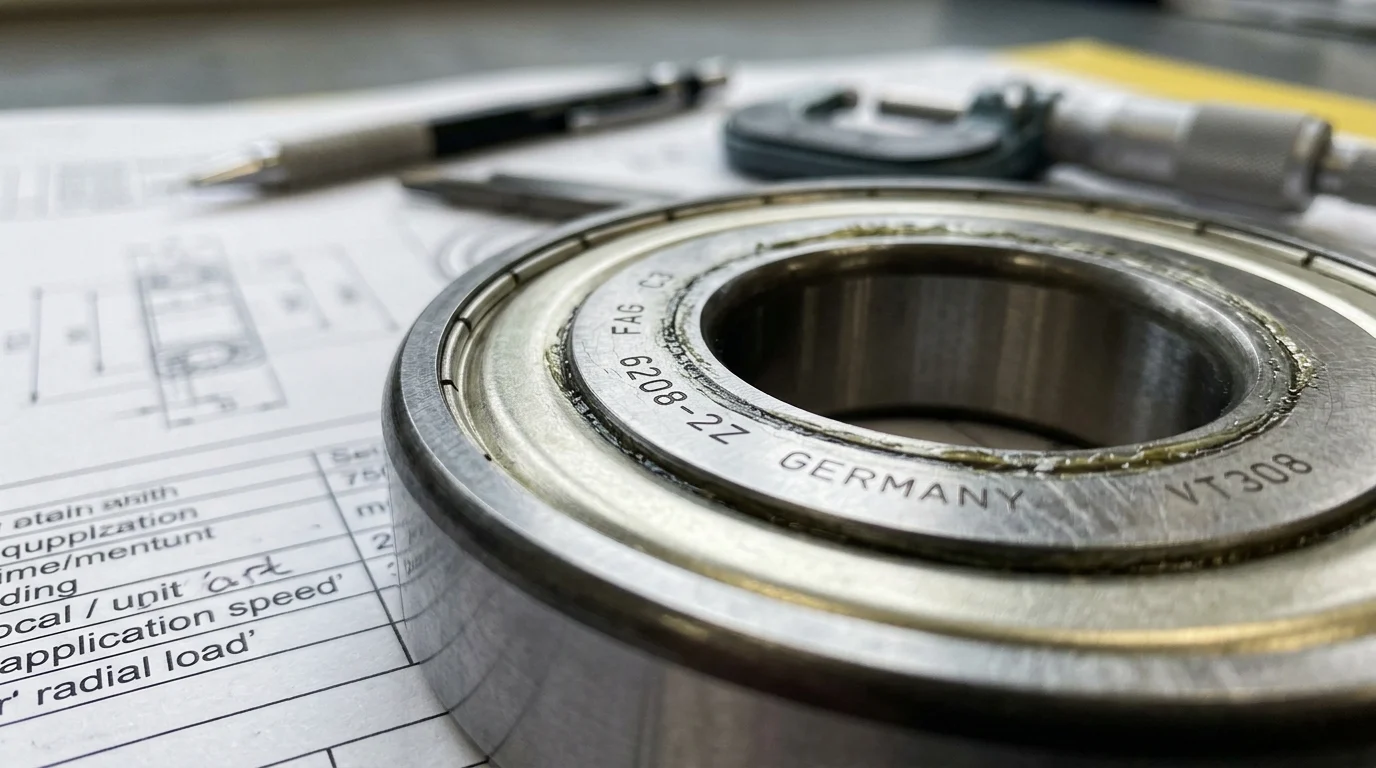
Translating operational demands into specific bearing parameters requires a rigorous evaluation of mechanical specifications. Engineers must balance load capacities, kinematic speed limits, and thermal constraints to identify a bearing that will achieve the desired L10h fatigue life.
Load, speed, temperature, and lubrication factors
Load parameters are categorized into radial and axial forces. The dynamic load rating (C) and static load rating (C0) dictate the bearing’s capacity to handle these operational stresses without yielding. Speed capabilities are evaluated using the bearing’s ndm value (mean bearing diameter multiplied by rotational speed), which determines the maximum permissible RPM before centrifugal forces and friction-induced heat exceed safe limits.
Temperature and lubrication are inextricably linked. Standard bearing steel (100Cr6) is typically dimensionally stabilized for operation up to 120°C, but specialized heat treatments are required for higher thresholds. Lubrication selection must account for the base oil viscosity at operating temperatures, ensuring a sufficient elastohydrodynamic (EHL) film thickness is maintained to separate the rolling elements from the raceways.
Bearing designs, clearances, and cage materials
Internal clearance is a critical design parameter, particularly for electric motors. The radial internal clearance must accommodate the thermal expansion of the shaft and inner ring during operation. Consequently, C3 clearance (greater than normal) is the standard specification for most industrial motor bearings, allowing for a temperature differential of roughly 10°C to 15°C between the inner and outer rings without causing destructive preloading.
Cage material selection further refines the bearing’s suitability for specific environments. Standard applications often utilize stamped steel cages due to their durability and cost-effectiveness. However, high-speed applications or those requiring low noise profiles frequently employ glass-fiber-reinforced polyamide (PA66) cages, which offer excellent sliding properties and elasticity. For heavy-duty or high-vibration applications, machined brass cages provide superior structural integrity, though they represent a higher initial cost.
Comparison criteria for common bearing types
Electric motors typically rely on a combination of bearing designs depending on their size, mounting orientation, and coupling method. Understanding the comparative strengths of these designs is essential for optimizing the drive and non-drive ends of the motor shaft.
| Bearing Type | Radial Load Capacity | Axial Load Capacity | Speed Limit | Typical Motor Application |
|---|---|---|---|---|
| Deep Groove Ball | Moderate | Low to Moderate | High | Small to medium motors, non-drive ends |
| Cylindrical Roller | Very High | None (unless flanged) | Moderate to High | Large motors, high belt loads |
| Angular Contact | Moderate | High (unidirectional) | High | Vertical motors, high thrust loads |
Deep groove ball bearings are the ubiquitous choice for small to medium motors due to their versatility and high-speed capabilities. Cylindrical roller bearings are specified for the drive end of large motors subjected to heavy radial loads, such as those driving industrial belts. Angular contact bearings are strictly required for vertical pump motors where continuous, heavy axial thrust loads must be supported.
How to compare motor bearings options
Comparing bearing options requires looking beyond basic dimensional compatibility. The subtle differences in insulation technologies, precision classes, and long-term maintenance requirements dictate the true value and performance of the component within an industrial system.
Standard vs insulated bearings
The proliferation of inverter-duty motors has made the choice between standard and insulated bearings a critical decision point. Standard steel bearings offer no resistance to VFD-induced shaft currents, making them highly susceptible to fluting and premature failure in inverter-driven applications.
Insulated bearings mitigate this risk through two primary technologies. Ceramic-coated bearings feature an aluminum oxide layer (typically 50 to 100 µm thick) applied to the outer or inner ring, providing a minimum breakdown voltage of 1,000V DC. For more severe high-frequency currents, hybrid bearings utilizing silicon nitride (Si3N4) rolling elements are specified. While hybrid bearings can cost 300% to 500% more than standard variants, their absolute electrical isolation and superior wear resistance make them the definitive solution for critical VFD applications.
Precision, noise, vibration, and fit
Precision standards directly impact the acoustic and vibratory performance of the motor. Bearings are manufactured to specific tolerance classes, such as ISO P0 (Normal), P6, or P5, correlating to ABEC 1, 3, and 5 standards. Electric motor quality (EMQ) bearings are specifically honed to tighter tolerances to minimize runout and ensure smooth operation.
Noise and vibration are further controlled through stringent manufacturing processes. Motor bearings are often categorized by vibration classes (e.g., V1, V2, V3), with V3 representing the lowest vibration velocity. Proper shaft and housing fits—typically an interference fit on the rotating shaft (e.g., k5 or m5 tolerances) and a transition or loose fit in the stationary housing (e.g., H6 or J6)—are mandatory to prevent fretting corrosion while allowing for axial thermal expansion.
Lifecycle cost beyond unit price
Procurement decisions driven solely by unit price frequently result in inflated lifecycle costs. A standard deep groove ball bearing may have a unit cost of $50, but the labor, equipment staging, and lost production time required to replace it can easily exceed $5,000 per event.
Engineers must evaluate the Total Cost of Ownership (TCO), which incorporates the bearing’s price, expected L10h life, required relubrication intervals, and the cost of potential downtime. Investing in a premium hybrid bearing or a sealed-for-life unit with high-performance synthetic grease often yields a positive return on investment within the first two years of operation by extending maintenance intervals from 4,000 hours to over 12,000 hours.
Selection and implementation process
A rigorous selection methodology must be paired with flawless implementation. Even the most highly engineered bearing will fail prematurely if subjected to improper installation techniques, inadequate storage, or poor lubrication practices.
Step-by-step selection workflow
The selection workflow begins with defining the application parameters: motor horsepower, RPM, mounting orientation, and coupling type. Next, engineers calculate the equivalent dynamic bearing load, factoring in both the rotor weight and external forces like belt tension. This data is used to calculate the theoretical L10h fatigue life, targeting an industry standard of 40,000 to 100,000 hours for continuous-duty industrial motors.
Once the base bearing size and type are established, the workflow proceeds to environmental adaptations. This includes selecting the appropriate internal clearance (typically C3), determining the necessity of electrical insulation, and specifying the optimal grease type and fill volume based on the operating temperature and speed.
Installation, storage, and lubrication practices
Installation procedures dictate the initial health of the bearing. Cold mounting with a mechanical press is acceptable for small bearings, but induction heating is mandatory for larger inner rings to achieve the necessary interference fit. The bearing should be heated to approximately 90°C to 110°C—strictly never exceeding 120°C for standard steel—to prevent metallurgical damage.
Storage conditions also impact bearing integrity. Bearings must be kept in their original, unopened packaging in a climate-controlled environment with relative humidity below 60% to prevent micro-corrosion. When packing an open bearing, the grease fill volume is critical; for electric motors, filling 30% to 50% of the free space is standard. Over-greasing causes churning, rapid temperature spikes, and premature failure of the lubricant.
Condition monitoring and maintenance
Proactive condition monitoring is essential for maximizing bearing life and preventing unplanned outages. Vibration analysis is the primary diagnostic tool, utilizing accelerometers to detect early-stage bearing defects (inner race, outer race, or rolling element faults) through acceleration enveloping techniques. ISO 10816 standards provide guidelines for acceptable motor vibration, typically requiring RMS velocity levels below 1.12 mm/s to 2.8 mm/s, depending on the motor class and mounting rigidity.
Acoustic emission testing and ultrasonic monitoring can detect high-frequency friction indicative of poor lubrication long before vibration anomalies appear. Routine maintenance must include disciplined relubrication practices, using the correct grease type and volume at calculated intervals. Maintenance teams must also avoid mixing incompatible grease thickeners (e.g., polyurea with lithium complex), which leads to catastrophic hardening or liquefaction of the lubricant.
How to evaluate suppliers and make the final choice
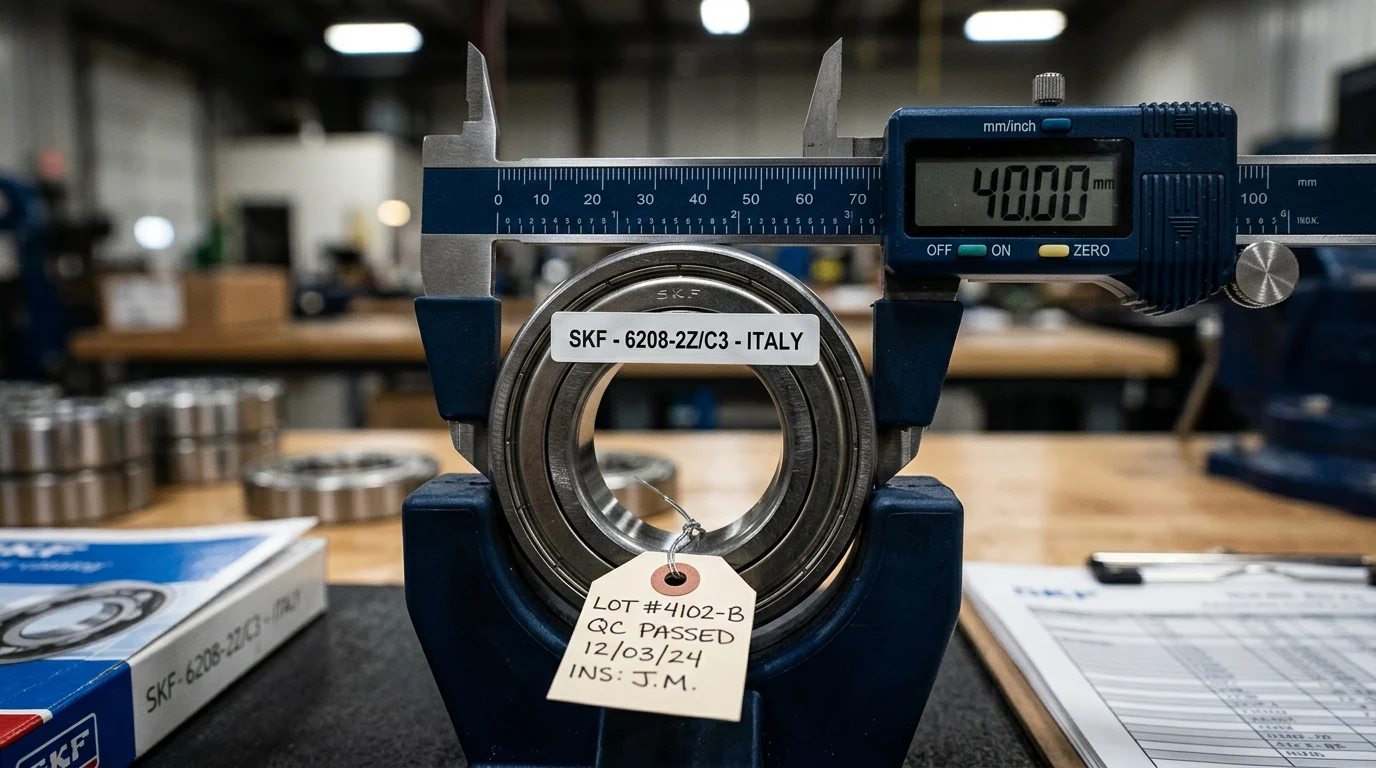
The final phase of bearing specification involves vetting the supply chain. Sourcing industrial bearings requires partnering with manufacturers and distributors capable of delivering consistent metallurgical quality, verified engineering data, and reliable logistics.
Supplier qualification and quality documentation
Supplier qualification must be rooted in stringent quality management standards. Tier-one bearing manufacturers operate under ISO 9001 and IATF 16949 certifications, ensuring rigorous process control. Buyers should demand comprehensive quality documentation, including EN 10204 3.1 material certificates, to verify steel cleanliness and precise chemical composition.
Defect rates are a critical metric for evaluating supplier capability. Premium industrial bearing suppliers typically maintain defect rates well below 50 Parts Per Million (PPM). Furthermore, the supplier must demonstrate robust counterfeit prevention protocols, as counterfeit bearings introduced through unauthorized distribution channels pose a severe safety and reliability risk to industrial operations.
Decision framework for technical fit, lead time, and cost
Selecting the final supplier requires balancing technical excellence with commercial realities. Application engineering support is a vital technical differentiator; suppliers who can provide advanced finite element analysis (FEA) and customized lubrication recommendations add significant value beyond the physical product.
| Evaluation Criteria | Priority Weight | Target Specification/Threshold | Verification Method |
|---|---|---|---|
| Quality System | 30% | ISO 9001 / IATF 16949 compliant | Third-party audit certificates |
| Defect Rate | 25% | < 50 Parts Per Million (PPM) | Historical quality control data |
| Material Traceability | 20% | EN 10204 3.1 Certification | Sample documentation review |
| Lead Time Reliability | 15% | > 95% On-Time Delivery (OTD) | Supply chain performance metrics |
| Technical Support | 10% | Dedicated application engineering | Pre-sales engineering response time |
Lead times heavily influence the final decision matrix.
Key Takeaways
- The most important conclusions and rationale for motor bearings
- Specs, compliance, and risk checks worth validating before you commit
- Practical next steps and caveats readers can apply immediately
Frequently Asked Questions
Which bearing type is most common for industrial motor applications?
Deep groove ball bearings are the usual first choice for electric motors because they handle high speed, low noise, and moderate radial/axial loads well.
When should I choose C3 clearance for a motor bearing?
Use C3 clearance in most industrial motors where shaft heat expands the inner ring. It helps prevent preload and overheating during continuous operation.
How do VFDs affect motor bearing selection?
VFD-driven motors may need insulated or hybrid ceramic bearings to reduce electrical discharge damage. This is especially important in high-speed or critical-duty equipment.
What factors matter most when selecting a motor bearing?
Check load, speed, operating temperature, contamination level, lubrication method, and whether the motor uses a VFD. These determine bearing type, clearance, seals, and cage material.
Can DEMY Bearings help OEMs and industrial buyers find suitable motor bearings?
Yes. DEMY Bearings offers a broad motor bearing range with e-catalog support, helping OEMs and distributors match specifications for speed, load, noise, and service life
Post time: May-19-2026