Introduction
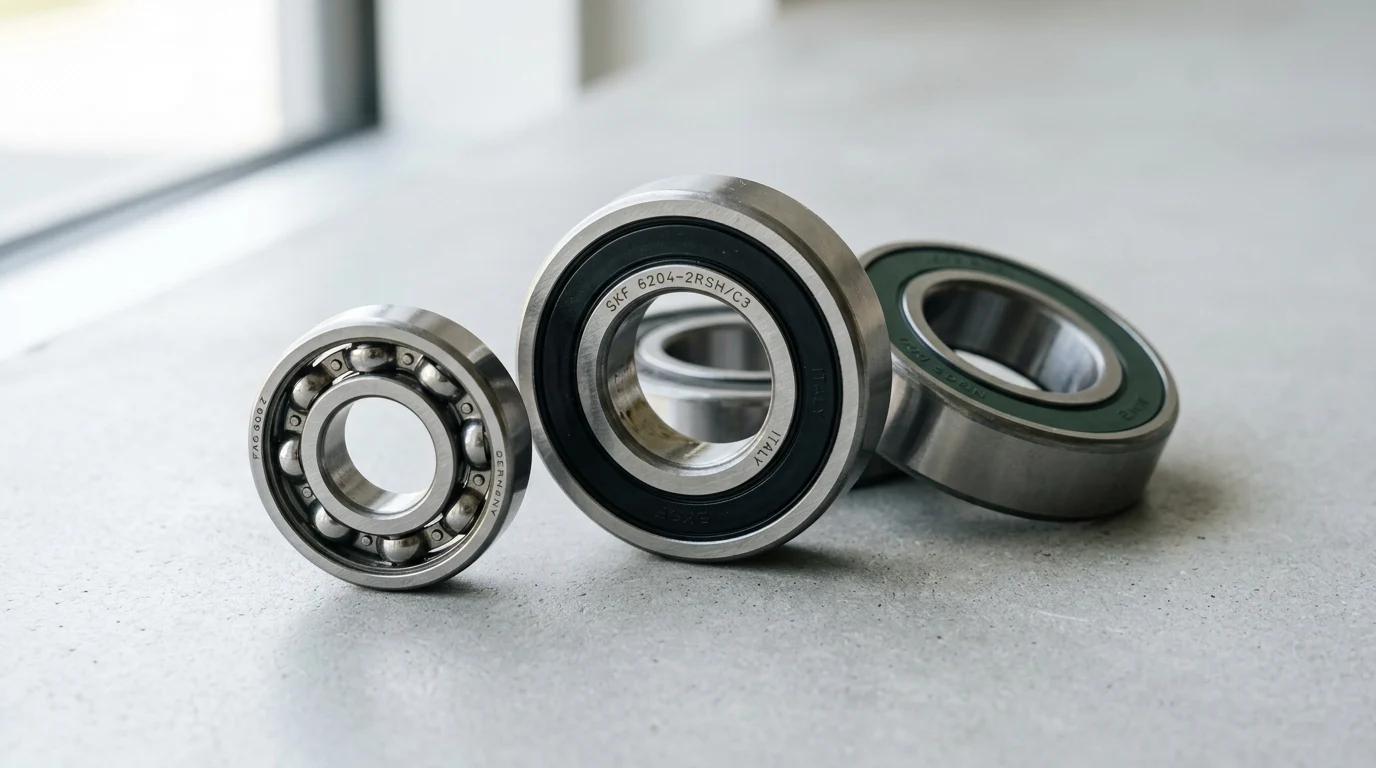
Selecting motor bearings for industrial service affects far more than shaft support: it shapes uptime, energy use, maintenance intervals, and failure risk. The right choice depends on matching bearing type, internal clearance, load profile, speed, temperature, lubrication method, and contamination exposure to the motor’s real operating conditions. This article explains the key selection factors, the tradeoffs between common bearing options, and the application details that often cause premature failures when overlooked. With that framework, you can evaluate specifications more confidently and choose bearings that improve reliability, efficiency, and service life in demanding industrial environments.
Why motor bearings matter for industrial reliability and efficiency
Industrial electric motors rely heavily on the mechanical integrity of their internal components, with motor bearings serving as the critical interface between the rotating shaft and the stationary housing. Properly specified motor bearings minimize friction, support radial and axial loads, and maintain precise shaft alignment under varying operational stresses.
Impact on uptime and energy efficiency
Bearing failures are the leading cause of electric motor breakdowns, accounting for approximately 51% of all motor failures in industrial environments. When bearing selection aligns with operational demands, facilities experience a direct improvement in mechanical uptime and overall equipment effectiveness (OEE).
Furthermore, optimized bearing geometry and surface finish reduce rolling resistance, which can yield a 1% to 2% reduction in total motor energy consumption. While this percentage seems small, it represents substantial financial savings for continuous-duty applications operating at high horsepower.
Operating risks that affect bearing performance
Industrial environments expose motor bearings to severe operating risks, including excessive thermal expansion, high-frequency vibration, and localized overheating. In heavy-duty applications such as steel mills or mining operations, ambient and operational temperatures can easily exceed 120°C, causing standard bearing steel to lose dimensional stability.
If the internal clearance is not specified correctly, this thermal expansion eliminates the critical lubrication film. The resulting metal-to-metal contact leads to micro-welding, rapid temperature spikes, and eventually, catastrophic spalling of the bearing raceways.
Motor bearing specifications that guide selection
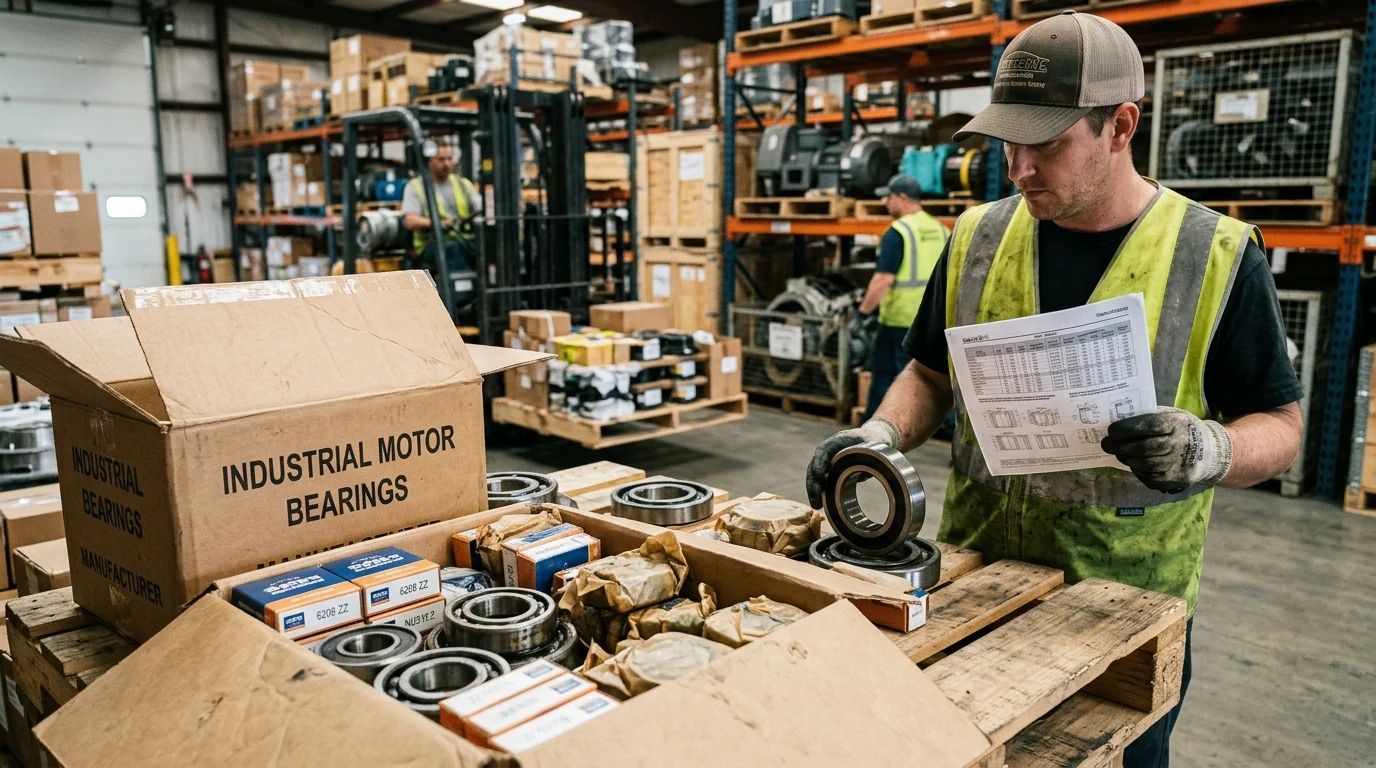
Selecting the correct motor bearings requires a rigorous evaluation of mechanical specifications and environmental constraints. Engineers must translate theoretical operating conditions into precise dimensional and material requirements to ensure long-term reliability.
Load, speed, temperature, lubrication, and duty cycle
The foundational metrics for bearing selection are the dynamic load rating (C) and static load rating (C0), which dictate the bearing’s theoretical L10 life. Speed limits are equally critical; standard deep groove ball bearings may easily accommodate 3,600 RPM for standard AC motors, whereas high-speed spindle motors operating above 10,000 RPM demand high-precision angular contact bearings.
Additionally, lubrication specifications, such as utilizing an NLGI Grade 2 polyurea-thickened grease, are vital for maintaining the hydrodynamic film at operating temperatures ranging from -20°C to 150°C.
Trade-offs among ball, roller, sleeve, and insulated bearings
Engineers must evaluate the mechanical trade-offs between different bearing architectures based on load trajectories and speed profiles.
| Bearing Type | Primary Load Capacity | Speed Limit | Typical Motor Application |
|---|---|---|---|
| Deep Groove Ball | Moderate Radial & Axial | High | Standard AC/DC integral motors |
| Cylindrical Roller | High Radial | Medium | Belt-driven motors, heavy radial loads |
| Sleeve (Fluid Film) | Extreme Radial | Very High | Multi-megawatt industrial turbines |
| Insulated/Hybrid | Moderate Radial & Axial | High | VFD-driven motors prone to arcing |
Selecting a cylindrical roller bearing, for example, increases radial load capacity by up to 60% compared to a similarly sized ball bearing, but sacrifices axial load capacity and introduces higher friction at elevated speeds.
Fits, clearances, tolerances, and material choices
Dimensional accuracy is governed by tolerance standards such as the ABEC scale, where standard industrial motors utilize ABEC 1 or 3, and precision servo motors require ABEC 5 or 7. Internal radial clearance is another paramount specification; the C3 clearance designation is the industry standard for electric motors.
A C3 clearance provides an additional 13 to 28 micrometers of radial play (for a standard 50mm bore) to safely accommodate thermal expansion without causing internal binding. Material choices are also critical; 52100 high-carbon anti-friction bearing steel serves as the baseline, while 440C stainless steel is deployed for highly corrosive environments.
How to compare motor bearing options by operating conditions
Beyond baseline specifications, the actual operating environment often dictates the final bearing configuration. Variations in external forces, ambient contaminants, and electrical architectures require highly specific bearing adaptations to prevent premature failure.
Comparison factors by application
Applications involving variable frequency drives (VFDs) or belt-driven loads impose unique stresses on motor bearings. Belt drives apply constant, unidirectional radial tension, necessitating robust roller bearings on the drive end. Conversely, direct-coupled applications typically experience lighter radial loads, allowing for standard deep groove ball bearings on both ends.
Engineers must also account for duty cycles. Motors subjected to frequent start-stop operations require lubricants with excellent channeling characteristics to prevent dry running during the initial milliseconds of rotation, when wear rates are historically highest.
Effects of contamination, vibration, misalignment, and shaft currents
Contamination and stray electrical currents are primary drivers of premature bearing failure. In VFD applications, parasitic capacitance generates high-frequency shaft voltages. When these voltages exceed the dielectric breakdown threshold of the lubricant—typically around 2 to 3 volts—electrical arcing occurs, causing pitting and fluting on the bearing raceways.
To mitigate this, engineers specify hybrid bearings with silicon nitride ceramic balls or steel bearings featuring aluminum oxide coatings capable of withstanding up to 1,000V DC. For contamination control, bearings operating in dusty or washdown environments require robust sealing solutions, such as dual-lip contact seals (2RS) that meet IP55 or IP66 ingress protection ratings without introducing excessive rotational drag.
Procurement, quality, and compliance when sourcing motor bearings
The mechanical integrity of a motor bearing is only as reliable as the supply chain that delivers it. Rigorous procurement protocols are essential to prevent the infiltration of counterfeit components and ensure consistent lot-to-lot quality.
Supplier quality systems and traceability
Procurement teams must audit supplier quality management systems, ensuring strict adherence to ISO 9001 and, for automotive or heavy-mobility applications, IATF 16949 standards. Traceability is non-negotiable; every bearing batch must feature laser-etched lot codes linking the component back to the original steel heat and manufacturing run.
Top-tier industrial bearing suppliers maintain defect rates strictly below 50 Parts Per Million (PPM). They achieve this by utilizing automated optical inspection and acoustic resonance testing to identify microscopic raceway anomalies before the product ever reaches the shipping dock.
Industry standards, OEM requirements, and documentation
Compliance with global dimensional and performance standards ensures interoperability and accurate lifespan calculations across global facilities. Procurement specifications must reference ISO 15 for rolling bearing boundary dimensions and ISO 281 for dynamic load ratings and rating life formulas.
For critical infrastructure applications, buyers should mandate comprehensive documentation packages upon delivery. These include Material Test Reports (MTRs) to verify metallurgical composition and Certificates of Conformance (CoC) to validate that dynamic radial clearances and ABEC tolerances precisely match the OEM purchase order requirements.
A practical workflow for choosing motor bearings
Establishing a standardized engineering and procurement workflow ensures that motor bearings are selected objectively, balancing technical necessity with commercial viability and supply chain constraints.
Step-by-step selection process
Implementing a structured selection matrix minimizes engineering errors and accelerates the design cycle for both OEMs and MRO teams.
| Phase | Action Item | Key Deliverable |
|---|---|---|
| 1. Load & Speed Analysis | Calculate radial/axial forces and maximum RPM | Required Dynamic Load Rating (C) |
| 2. Architecture Selection | Choose ball, roller, or hybrid design | Bearing type and dimensional envelope |
| 3. Clearance & Tolerance | Specify internal clearance and precision grade | Designation (e.g., C3, ABEC 3) |
| 4. Environmental Mitigation | Select seals, shields, and lubrication | Seal type (e.g., ZZ, 2RS) and grease spec |
This methodical approach guarantees that critical variables, such as shaft voltage mitigation and thermal expansion allowances, are addressed sequentially rather than treated as expensive afterthoughts during the prototyping phase.
Final criteria to balance performance, availability, and cost
The final selection must weigh optimal mechanical performance against Total Cost of Ownership (TCO), lead times, and availability. While custom-engineered bearings offer superior application matching, they frequently require Minimum Order Quantities (MOQs) ranging from 500 to 1,000 units and involve lead times of 12 to 16 weeks.
Conversely, standard catalog bearings are available immediately but may require slight motor design compromises. By evaluating the cost of unexpected downtime against the premium paid for specialized components—such as accepting a 300% price premium for ceramic hybrid bearings to permanently eliminate VFD-induced failures—organizations can make financially sound, reliability-driven procurement decisions.
Key Takeaways
- The most important conclusions and rationale for motor bearings
- Specs, compliance, and risk checks worth validating before you commit
- Practical next steps and caveats readers can apply immediately
Frequently Asked Questions
Which bearing type is best for a standard industrial motor?
Deep groove ball bearings are the usual choice for standard AC/DC motors because they handle moderate radial and axial loads and run efficiently at common speeds like 3,600 RPM.
When should I use insulated or hybrid motor bearings?
Use them on VFD-driven motors to reduce electrical arcing and fluting. They are a practical upgrade when inverter duty, high switching frequency, or repeated premature bearing failure is present.
Why is C3 clearance commonly used in motor bearings?
C3 gives extra internal clearance to absorb thermal expansion during operation. For most electric motors, it helps maintain lubrication film and prevents binding as temperatures rise.
What bearing works better for belt-driven motors?
Cylindrical roller bearings often suit the drive end because they carry higher radial loads from belt tension. Check axial load needs, since roller bearings are less suitable for axial support.
How can I choose a reliable motor bearing supplier?
Look for ISO/TS16949-backed production, precision testing, and a broad motor-bearing catalog. On DEMY Bearings, buyers can compare ball and roller options in the e-catalog and request application-specific support.
Post time: May-25-2026